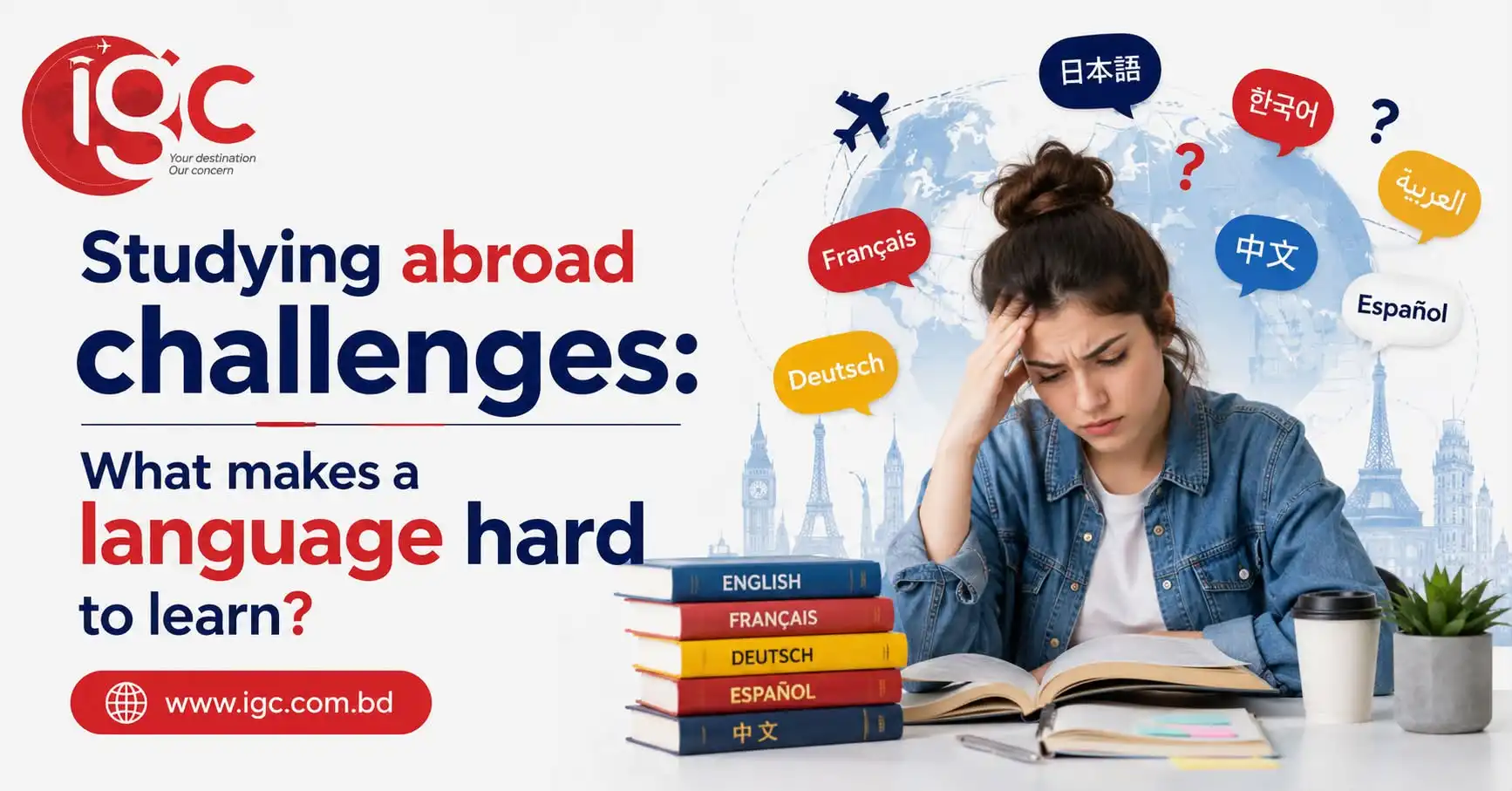
Studying abroad challenges: What makes a language hard to learn? This question sits at the heart of every international student’s journey. When a student leaves Bangladesh to study in a foreign country, language becomes more than a subject. It becomes a daily survival tool. It shapes how students learn, communicate, and build relationships. Studying abroad challenges: What makes a language hard to learn? is not just about grammar rules or vocabulary lists. It is about fear, confidence, identity, and adaptation.
Many Bangladeshi students grow up learning English in school. Yet, when they reach countries like the UK, Canada, or Australia, they often feel lost. The classroom English they learned does not always match real-life communication. This gap creates stress. It also affects academic performance and social life. Studying abroad challenges: What makes a language hard to learn? becomes a real-life problem that students must solve every day.
Understanding Language Difficulty: More Than Just Words
When we talk about Studying abroad challenges: What makes a language hard to learn?, we must first understand that language difficulty is not the same for everyone.
Key factors that make a language hard:
For Bangladeshi students, English itself can still feel difficult in real-life situations. Even after scoring 6.0 or 7.0 in IELTS, many struggle with listening and speaking.
Studying abroad challenges: What makes a language hard to learn? is deeply connected to culture.
Language is shaped by culture. Words carry meaning beyond their dictionary definition. Tone, gestures, and context matter.
Real-life example:
Rafiq, a student from Dhaka, went to Australia for his Bachelor’s degree. He could speak English well. But he struggled to understand jokes and casual conversations. His classmates used slang and idioms that he never learned in Bangladesh.
He once said:
“I knew the words, but I did not understand the meaning.”
This shows that language difficulty is not just about vocabulary. It is about understanding how people think and communicate.
Academic Pressure: Language in the Classroom
One of the biggest parts of Studying abroad challenges: What makes a language hard to learn? is academic pressure.
Challenges faced:
Many Bangladeshi students feel shy to speak in class. They fear making mistakes. This fear slows down their progress.
Hypothetical story:
Nusrat moved to the UK for her Master’s degree. In her first semester, she avoided speaking in class. She thought her English was not good enough. Her grades suffered because participation was part of the assessment.
Later, she joined a university language support program. Within three months, she improved her confidence. By the end of the year, she was actively participating.
Social Isolation: The Hidden Cost of Language Difficulty
Studying abroad challenges: What makes a language hard to learn? also affects social life.
When students cannot express themselves easily, they feel isolated.
Common issues:
Many Bangladeshi students stay within their own community. While this provides comfort, it limits language growth.
Practical advice:
Financial Stress and Language Learning
Financial constraints are a major part of Studying abroad challenges: What makes a language hard to learn?.
Many Bangladeshi students work part-time jobs. This reduces the time they can spend learning the language.
Reality:
Real-life insight:
Hasan, a student in Canada, worked 20 hours a week in a restaurant. He interacted with customers daily. At first, he struggled. But over time, this job became his best language training.
He said:
“My workplace was my classroom.”
Psychological Barriers: Fear and Confidence
One of the most overlooked aspects of Studying abroad challenges: What makes a language hard to learn? is psychological.
Common fears:
These fears can be stronger than grammar problems.
Solution:
Confidence grows with use, not perfection.
Studying abroad challenges: What makes a language hard to learn? also depends on how different the new language is from your native language.
Examples:
The greater the difference, the harder the learning process.
Technology and Language Learning
Modern tools have reduced Studying abroad challenges: What makes a language hard to learn? to some extent.
Helpful tools:
However, technology cannot replace real-life interaction.
Let us consider a combined story inspired by many Bangladeshi students.
Arif went to Australia with an IELTS score of 6.5. In his first month, he could not understand lectures fully. He felt lost and lonely.
He started small:
After six months, his confidence improved. After one year, he was helping new students.
This shows that Studying abroad challenges: What makes a language hard to learn? can be overcome with effort and patience.
Here are some practical solutions:
Before going abroad:
After arriving:
Long-term:
Layered Analysis: Why Language Feels Hard
Let us break down Studying abroad challenges: What makes a language hard to learn? into layers:
True mastery requires working on all levels.
Studying abroad challenges: What makes a language hard to learn? is a complex issue. It involves grammar, culture, confidence, and real-life experience. Bangladeshi students face unique challenges, including financial pressure and cultural differences. However, with effort, practice, and the right mindset, these challenges can be overcome. Language learning is a journey, not a barrier.
FAQs: Real Questions from Aspiring Students
1. Why do I feel my English is not enough even after IELTS?
IELTS tests academic skills, but real-life communication is different. You need practice in daily conversations.
2. Is it normal to struggle with language in the beginning?
Yes. Almost every international student faces this problem.
3. How long does it take to become confident?
It usually takes 3 to 6 months of regular practice.
4. Should I avoid speaking if I make mistakes?
No. Speaking is the only way to improve.
5. How can I improve listening skills?
Watch movies, listen to podcasts, and talk to native speakers.
6. Do part-time jobs help with language learning?
Yes. They provide real-life communication practice.
7. What if I feel shy in class?
Start small. Ask simple questions. Confidence will grow.
8. Can I rely only on apps to learn language?
Apps help, but real interaction is more important.
9. How can I understand accents better?
Exposure is key. Listen to different speakers regularly.
10. Is grammar the most important part?
Grammar is important, but communication matters more.
11. How do cultural differences affect language learning?
They affect meaning, tone, and understanding of conversations.
12. What should I do if I feel isolated?
Join student groups and participate in activities.
13. Can I succeed academically with weak language skills?
Yes, but you must work hard to improve quickly.
14. What is the biggest challenge for Bangladeshi students?
Confidence and real-life communication are the biggest challenges.
15. What is the best way to overcome fear?
Practice daily and accept mistakes as part of learning.
Studying abroad challenges: What makes a language hard to learn? is not just an academic question. It is a human experience. It is about growth, struggle, and success. Every Bangladeshi student who goes abroad faces this journey. And every one of them has the power to overcome it.