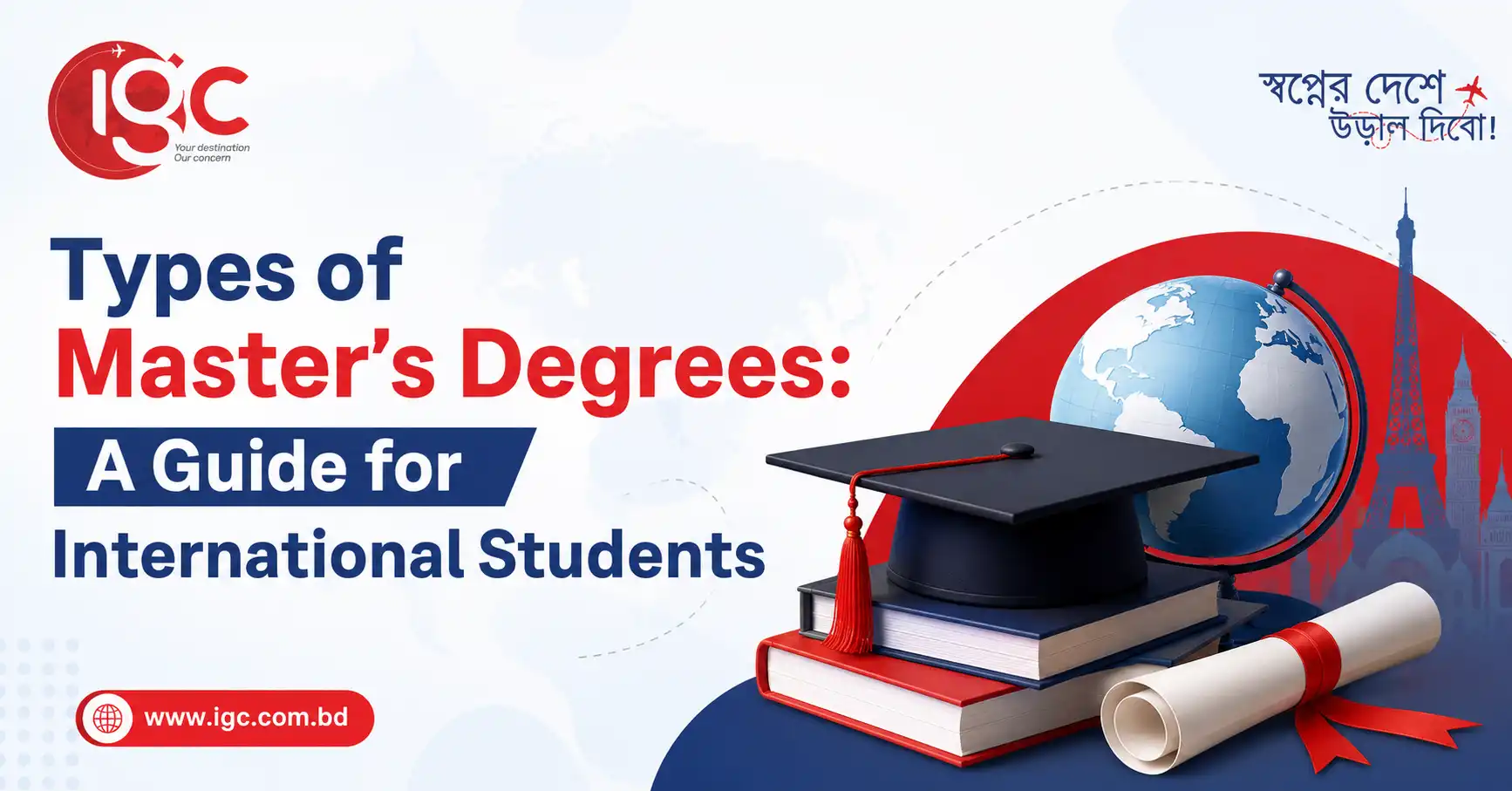
When a student decides to study abroad, one of the first and most confusing questions is about the Types of Master's Degrees. Many Bangladeshi students feel lost at this stage. They hear terms like MSc, MA, MBA, MRes, and MPhil, but they do not fully understand what these mean. This confusion can lead to wrong choices, wasted money, or even visa refusal.
The topic Master's Degrees is not only about knowing names of degrees. It is about understanding your career path, your learning style, and your future plans. For example, a student who wants a research career should not choose a course designed only for job skills. Similarly, a student who wants a quick job after graduation should not select a long research-focused program.
In Bangladesh, many students depend on agents or friends for advice. Sometimes this advice is incomplete. That is why a clear and simple explanation of Types of Master's Degrees is very important. This guide will explain each type of degree in simple words. It will also share real-life stories, challenges, and practical advice.
By the end of this article, you will not only understand Master's Degrees for International Students, but you will also feel confident to choose the right program for your future.
Before going into details, it is important to divide Types of Master's Degrees: into two main groups:
1. Academic Degrees
These focus on theory and research.
2. Professional Degrees
These focus on skills and jobs.
For example, Rahim from Dhaka wanted to become a university teacher. He chose MSc in Physics. On the other hand, his friend Karim chose an MBA because he wanted to work in a company.
Both made the right choice because they understood the difference.
Master of Science (MSc): A Popular Choice in Types of M's Degrees
The MSc is one of the most common options in Types of Master's Degrees.
Key Features:
Real Example:
Nusrat from Chattogram completed her BSc in Computer Science. She went to the UK for an MSc in Data Science. During her studies, she worked on real datasets. After graduation, she got a job in a tech company.
Best For:
The MA is another important part of
Key Features:
Real Story:
Emon from Bogura studied English. He chose an MA in TESOL in the UK. Now he works as an English instructor.
Best For:
Master of Business Administration (MBA): Career-Oriented Path in Master's Degrees
The MBA is very popular in Types of Master's Degrees, especially among Bangladeshi professionals.
Key Features:
Real Example:
Mehedi worked in a company in Dhaka for five years. He then went to Australia for an MBA. After finishing, he returned to Bangladesh and got a higher position.
Why Students Choose MBA:
The MRes is a research-heavy degree in Types of Master's Degrees: A Guide for International Students.
Key Features:
Example:
A student interested in AI research may choose MRes instead of MSc.
Best For:
The MPhil is another research-focused option in Types of Master's Degrees
Key Features:
Real Insight:
Many Bangladeshi students choose MPhil after MSc if they want academic careers.
There are also specialized degrees in Types of Master's Degrees: A Guide for International Students such as:
Real Example:
A student from Sylhet chose MPH to work in public health organizations like NGOs.
Understanding this difference is very important in Types of Master's Degrees
Coursework:
Research:
Advice:
If you are not comfortable writing long research papers, choose coursework.
While exploring Types of Master's Degrees for International Students, Bangladeshi students face many challenges:
1. Financial Problems
Studying abroad is expensive. Tuition fees can range from $10,000 to $40,000 per year.
2. Cultural Differences
Students may struggle with language, food, and lifestyle.
3. Lack of Information
Many students do not understand the differences between degrees.
Practical Tips:
To understand Types of Master's Degrees: A Guide for International Students, follow these steps:
Let us consider a story.
Arif from Cumilla wanted to study abroad. He was confused about Types of Master's Degrees: A Guide for BD Students. At first, he planned to apply for MBA. But after research, he realized his background in IT was better suited for MSc in Cyber Security.
He worked hard, applied for scholarships, and went to the UK. Today, he works in a multinational company.
His success came from understanding the right degree.
These numbers show the importance of understanding Types of Master's Degrees.
Understanding Master's Degrees for International Students is very important for making the right study decision. Different degrees serve different goals. Students must match their interests, background, and career plans before choosing. With proper research and planning, Bangladeshi students can succeed globally.
It depends on your background and career goal. MSc is good for science students. MBA is good for professionals.
MSc includes coursework and research. MRes is mainly research-based.
Usually MBA is better after work experience.
Yes, but it depends on the university requirements.
UK, Australia, Canada, and USA are popular choices.
It can cost between $15,000 to $50,000 per year including living expenses.
Yes, many universities offer partial and full scholarships.
Most universities require IELTS or similar tests.
It focuses on assignments and exams.
It focuses on thesis and research work.
Yes, most countries allow part-time work.
Match your interest, career goal, and academic background.
If documents are correct and genuine, chances are high.
Choosing wrong course, poor research, and relying on wrong advice.
Many students return and build strong careers. It depends on your plan.