Canada Student Visa Processing Bangladesh: A Complete Guide for Bangladeshi Students
For many young people in Bangladesh, studying in Canada is more than an academic dream. It is often a major family decision involving years of preparation, financial sacrifice, emotional pressure, and hope for a better future. A student may spend months preparing for an English language test, choosing a university or college, arranging funds, collecting documents, and discussing the decision with parents. This is why understanding Canada student visa processing Bangladesh is extremely important before taking the first serious step.
The process may look simple from outside. Get admission, submit documents, provide biometrics, and wait for a decision. In reality, each stage needs careful planning. A weak course choice, unexplained source of funds, incomplete document, unclear study purpose, or inconsistent information may create difficulties.
These changes mean that students should not depend on advice that was accurate several years ago. A Facebook post, YouTube video, old blog, or friend's experience may no longer reflect current requirements.
This guide explains the complete journey in simple language. It discusses admission, study permit applications, funds, biometrics, PAL and TAL requirements, common mistakes, cultural adjustment, and practical challenges faced by Bangladeshi families.
What Does Canada Student Visa Processing Bangladesh Actually Mean?
People commonly use the words "Canada student visa," but technically, most international students need a study permit to study at a designated learning institution in Canada. The study permit is the official document that allows an eligible foreign national to study in Canada. The current government fee for a Canadian study permit is CAD 150.
Depending on the student's situation, other requirements may include biometrics, medical examinations, a provincial attestation letter, financial documents, and additional supporting evidence.
For a Bangladeshi student, the process usually begins before the immigration application itself. First, the student must find an appropriate educational institution and obtain an acceptance letter.
So, the journey normally looks like this:
- Choose a suitable institution and program.
- Meet the admission requirements.
- Receive a letter of acceptance.
- Obtain a PAL or TAL where required.
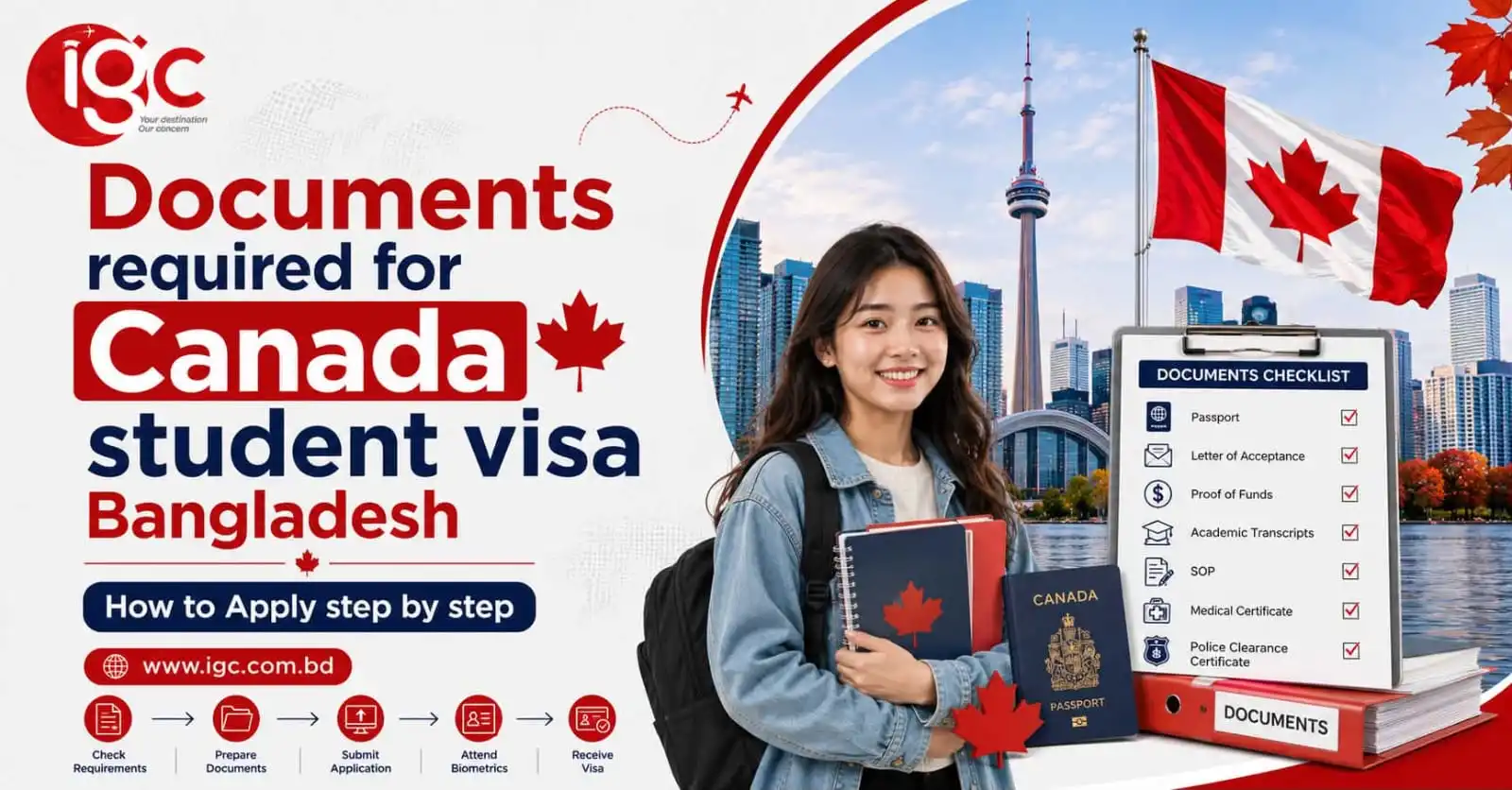
- Prepare financial and personal documents.
- Submit the study permit application.
- Provide biometrics if required.
- Complete medical or additional requirements when applicable.
- Wait for processing and a final decision.
- Prepare for travel after approval.
This is why Canada Student Visa Processing Bangladesh: A Complete Guide for Bangladeshi Students should be understood as a complete academic, financial, immigration, and personal preparation process rather than a simple online form submission.
Start With the Right Course and Institution
Let us consider a hypothetical Bangladeshi student named Hasan.
Hasan completed a BSc in Computer Science and Engineering from a private university in Dhaka. He then worked for two years as a software developer. While searching for Canadian programs, an agent suggested an unrelated basic hospitality program because admission appeared easier.
Hasan should stop and ask a very important question:
Why should a software engineer with professional IT experience suddenly study an unrelated basic hospitality course?
There may be genuine reasons for changing careers, but the academic choice should have a clear and truthful explanation.
For Hasan, courses such as data science, cybersecurity, artificial intelligence, software engineering, information systems, or technology management may offer a more understandable connection with his previous studies and experience.
Canadian study permit applicants need a letter of acceptance from a designated learning institution, commonly called a DLI. Students should carefully verify whether their selected institution and program meet relevant requirements.
Choosing the correct program is therefore not simply about getting an offer letter. It is about building a believable academic journey.
Why Academic Relevance Matters
A student's educational history tells a story.
Suppose Nusrat completed a bachelor's degree in pharmacy and has worked for three years in pharmaceutical quality control. She now wants to pursue graduate studies related to pharmaceutical sciences, biotechnology, public health, regulatory affairs, or healthcare management.
Her academic direction has a visible connection.
Now imagine another student with exactly the same background suddenly choosing a very basic program in an unrelated subject without explaining the change. That decision may require more careful justification.
A change of subject is not automatically wrong. People change careers all the time. However, the student should be able to explain:
- Why is the new subject important?
- What caused the change in career direction?
- How does the new program support future goals?
- Why is Canada suitable for this particular education?
- Why was the chosen institution selected?
The strongest applications are generally built around truth and clear reasoning rather than artificial stories.
Understanding the Letter of Acceptance
A letter of acceptance is one of the key documents for a Canadian study permit application. It must normally come from the designated learning institution the student plans to attend.
Students should carefully check:
- The exact name of the institution
- The program title
- Program duration
- Starting date
- Tuition information
- Any conditions attached to admission
- Campus location
- DLI-related information where relevant
A student should never assume that every institution advertised online automatically offers the same opportunities or immigration outcomes.
Ask questions before paying large deposits.
- Talk directly with the institution when necessary.
- Keep copies of receipts and official communication.
- Do not let excitement replace careful verification.
- Understanding PAL and TAL Requirements
One of the most important parts of the current Canadian international student system is the provincial attestation letter, called PAL, or territorial attestation letter, called TAL.
In most cases, applicants who require one must include it in their application. A PAL or TAL generally confirms that the applicant has been accounted for under the relevant provincial or territorial allocation.
However, not every student is treated in exactly the same way.
Starting January 1, 2026, students entering degree-granting master's or doctoral programs at eligible public institutions do not need a PAL or TAL for their study permit application. Quebec continues to have its own provincial requirements.
This is an excellent example of why Canada student visa processing Bangladesh cannot be based on old information.
A student who applied in 2023 may have faced different requirements from someone applying in 2026.
Always check current official guidance before submission.
The Financial Reality for Bangladeshi Families
Money is often one of the most difficult parts of the process.
For a middle-income Bangladeshi family, studying in Canada can represent years of savings. Parents may sell land, use fixed deposits, take an education loan, or combine several legitimate sources of money.
Consider a hypothetical student named Maliha from Chattogram.
Her father owns a small trading business. The family can support her studies, but the income does not come through a simple monthly salary. Money moves through business accounts, customer payments, savings, and fixed deposits.
The family's challenge is not only having money. It is explaining the financial story clearly.
Canadian immigration guidance requires students to demonstrate enough money for tuition, living expenses, and transportation without depending on employment in Canada. For applications made on or after September 1, 2025, one applicant studying outside Quebec needs to demonstrate CAD 22,895 for one year of living expenses, excluding tuition and transportation.
Therefore, a Bangladeshi family should calculate the complete cost, including:
- Tuition fees
- Living expenses
- Airfare
- Accommodation deposits
- Health-related costs
- Books and study materials
- Transportation
- Winter clothing
- Emergency expenses
- Exchange-rate changes
Do not create a budget based only on the minimum required amount.
Source of Funds Is as Important as the Amount
Imagine a student's sponsor earns BDT 80,000 per month. Suddenly, BDT 50 lakh appears in the bank account shortly before the application.
The obvious question is: Where did this money come from?
There may be a perfectly valid answer.
- Perhaps property was sold.
- Perhaps a fixed deposit matured.
- Perhaps the family received legitimate business income.
- Perhaps the sponsor has accumulated savings over many years.
- Perhaps an education loan was approved.
The important point is that the financial evidence should tell a clear and truthful story.
Official Canadian guidance lists several possible forms of financial evidence, including proof of tuition or housing payments, bank statements, a student or education loan, a Canadian bank account, a guaranteed investment certificate where applicable, or financial support from another person. Bank statements covering the previous four months may also be used as one form of proof.
- Never submit fabricated financial documents.
- Never create false employment papers.
- Never allow someone to place incorrect information in your application simply because they say, "Everyone does it."
- Your application is your responsibility.
- Canada Student Visa Processing Bangladesh and the Importance of Biometrics
- Many applicants need to provide biometrics as part of the Canadian immigration process.
- The individual biometrics fee is currently CAD 85.
- After submitting an application, an applicant who is required to provide biometrics may receive a biometric instruction letter. The student then follows the official instructions to complete the process.
- Bangladeshi students should avoid delaying this stage unnecessarily.
- Check your account regularly.
- Read official letters carefully.
- Follow the instructions exactly.
Do not depend only on phone calls or messages from an agent. Keep personal access to your application records wherever possible.
The application process belongs to the student, even when professional assistance is used.
How Long Does Canada Student Visa Processing Take from Bangladesh?
This is one of the most common questions.
Unfortunately, there is no single permanent answer.
Canadian immigration authorities state that processing time varies depending on the type of application, the location where it is processed, application volume, complexity, and whether the submitted application is complete. Processing-time information is updated regularly.
This means a student should not treat another person's timeline as a guarantee.
For example:
- Rafi may receive a decision relatively quickly.
- Nadia may wait longer because additional information is required.
- Sami's case may take more time because of medical or document-related requirements.
- Another application may be affected by seasonal application volume.
Therefore, the best approach is to apply early and monitor current official processing times.
Never book non-refundable travel simply because someone tells you that approval will arrive on a certain date.
A Story About Rafi and His Financial Mistake
Rafi was a hypothetical student from Sylhet who wanted to study supply chain management in Canada.
His academic background was suitable. His English score was acceptable. His father's business could support the cost.
But Rafi made one mistake.
He waited until the final moment to organise financial documents.
Two weeks before submission, large amounts of money were moved between several family accounts. Rafi himself could not clearly explain every transaction.
His consultant asked him basic questions:
- Who owns this account?
- Where did this deposit come from?
- Why was this money transferred?
- Can you provide supporting documents?
Rafi realised that financial preparation should have started much earlier.
He delayed his application, collected business documents, bank records, tax-related evidence where applicable, and proof explaining major transactions.
The lesson is simple. Canada Student Visa Processing Bangladesh: A Complete Guide for Bangladeshi Students is not only about having enough money. It is about creating a transparent and understandable record of how that money was earned, saved, borrowed, or received.
Writing a Genuine Study Plan or Statement of Purpose
A student's written explanation should sound like a real human story, not a copied advertisement about Canada.
Weak statements often say things such as:
- Canada has world-class education.
- Canada is multicultural.
- Canada offers excellent opportunities.
- These points may be true, but thousands of students can write exactly the same sentences.
The more important questions are personal:
- Why did you choose this subject?
- Why this institution?
- How does the program relate to your previous studies?
- How will it help your professional future?
- Why does the financial investment make sense?
- What career direction are you pursuing?
Consider a student named Samia who studied environmental science in Bangladesh and worked on water-quality research. She chooses a Canadian graduate program related to environmental monitoring and sustainable resource management.
Her story can discuss actual academic interests, field experience, Bangladesh's environmental challenges, and the skills she wants to develop.
That is much stronger than copying a general SOP template.
Common Mistakes Made by Bangladeshi Applicants
Understanding mistakes is an important part of Canada Student Visa Processing Bangladesh: A Complete Guide for Bangladeshi Students.
Common problems may include:
- Choosing an unrelated course without good explanation
- Depending completely on an agent
- Submitting inconsistent information
- Failing to explain major bank deposits
- Using copied SOPs
- Ignoring academic gaps
- Underestimating total cost
- Assuming a part-time job will fund everything
- Using outdated immigration information
- Submitting documents without reading them
- Applying too late
- Ignoring conditions in the admission letter
- A careful student should slow down and ask questions.
- Being fast is not always better.
- Being prepared is better.
- Do Not Depend Entirely on Part-Time Work
This deserves special attention because many Bangladeshi students hear stories about earning money after arriving in Canada.Eligible international students may currently work up to 24 hours per week off campus during regular academic terms. Eligible students can work unlimited hours during scheduled academic breaks, subject to the applicable conditions.
However, part-time employment should not be treated as guaranteed income.
- A student may need time to find a job.
- Work availability varies.
- Living expenses may be high.
- Academic studies require time.
- Illness or unexpected problems can occur.
- The financial plan should be strong enough before leaving Bangladesh.
- Do not tell yourself, "I will somehow pay everything after getting a job."
- That is hope, not financial planning.
- Cultural Challenges After Arriving in Canada
- The visa is not the end of the journey.
A Bangladeshi student who has always lived with parents may suddenly need to:
- Cook every day
- Do laundry
- Manage rent
- Travel alone
- Attend classes in winter
- Communicate in English
- Complete independent assignments
- Work with students from different cultures
- Handle loneliness
- Manage money carefully
Imagine Tahmid, a student from Dhaka, arriving in Canada during winter.
In Bangladesh, he never cooked. His mother handled meals. He had never experienced severe cold. During his first month, he struggled with grocery shopping, transportation, loneliness, assignments, and basic daily responsibilities.
- This is not failure. It is adjustment.
- Before departure, students should learn practical life skills.
- Cook five or six simple meals.
- Learn basic budgeting.
- Research accommodation carefully.
- Understand public transport.
- Practice communicating confidently.
- Learn how to ask teachers for help.
- Talk honestly about homesickness.
A good international education journey needs emotional preparation as much as academic preparation.
Why Students Should Keep Control of Their Own Application
Using a consultant is not automatically a problem. Many students seek professional guidance because the process can feel complicated. However, never surrender complete control.
You should know:
- Which institution you are applying to
- Which program you selected
- How much tuition you will pay
- What is written in your SOP
- What financial evidence is submitted
- What employment history is declared
- What family information appears in the forms
- Which email address is being used
- Which documents are uploaded
A simple rule is useful:
- Never allow anyone to submit information under your name that you would be unable to explain yourself.
- That principle protects students from many avoidable problems.
Why Canada Student Visa Processing Bangladesh Requires Early Preparation
Strong applications rarely come together in one night.
A student may need time for:
- English language preparation
- University research
- Academic transcripts
- Recommendation letters
- Employment evidence
- Bank documents
- Loan processing
- Property-related records
- Medical requirements
- PAL or TAL arrangements
- SOP preparation
- Application review
- Starting early gives students time to correct weaknesses.
- A student with a low English score may retake the test.
- A student with unclear financial documents may organise them properly.
- A student choosing the wrong program may reconsider.
- A rushed applicant often has fewer options.
Current Changes Bangladeshi Students Should Understand
- For 2026, Canada expects approximately 408,000 study permits to be issued across various student categories, including about 180,000 for applicants who require PAL or TAL documents.
- Starting January 1, 2026, applicants entering degree-granting master's and doctoral programs at eligible public institutions are exempt from the PAL or TAL requirement.
- Eligible international students can work up to 24 hours per week off campus during regular academic periods.
- The study permit application fee remains CAD 150, while individual biometrics currently cost CAD 85.
- These details show why current official information matters.
- A video published several years ago may no longer be reliable.
A Practical Checklist Before Submission
Before submitting an application, ask yourself:
- Is my program logically connected with my education or career?
- Can I explain why I chose this institution?
- Do I understand my complete financial plan?
- Can I explain major deposits?
- Are my academic and employment dates consistent?
- Have I personally read my SOP?
- Do I know what documents are being submitted?
- Have I checked current official requirements?
- Do I understand PAL or TAL requirements for my case?
- Have I given myself enough time before the semester begins?
If you cannot confidently answer these questions, pause and review your case.
The Human Side of Canada Student Visa Processing Bangladesh
- Behind every application is a human story.
- A father may use years of savings.
- A mother may worry silently about her child living thousands of kilometres away.
- A student may fear disappointing the entire family.
- Another may feel embarrassed after a refusal.
- A young woman may be excited about independence but nervous about living alone for the first time.
- These feelings are normal.
The process should therefore never be treated only as forms, bank statements, and application numbers.
- A Complete Guide for Bangladeshi Students is ultimately about making a major life decision responsibly.
- Not every student needs to rush.
- Sometimes it is better to improve an English score.
- Sometimes more work experience may strengthen academic direction.
- Sometimes choosing a cheaper program is wiser.
- Sometimes waiting six months is better than making a poor decision under pressure.
- Good planning respects both ambition and reality.
Summary
Canada Student Visa Processing Bangladesh: A Complete Guide for Bangladeshi Students shows that a successful study journey requires far more than obtaining an admission letter. Students need a relevant academic plan, transparent financial preparation, genuine documentation, updated knowledge of Canadian requirements, personal control over their applications, and emotional readiness for life abroad. Careful preparation cannot guarantee approval, but it can help students avoid preventable errors and make more informed decisions.
Frequently Asked Questions
1. What is the first step in applying for a Canadian student visa from Bangladesh?
- The first practical step is to identify a suitable educational institution and program that fits your academic history, professional experience, financial ability, and future career goal.
- You normally need an acceptance letter from a designated learning institution before applying for a study permit.
- Do not select a course only because an agent says admission is easy.
- Research the program content, tuition, institution, location, and academic requirements carefully.
- You should also check whether a PAL or TAL is required in your situation.
- Good preparation at this stage can prevent expensive mistakes later.
2. How long does Canada student visa processing take for Bangladeshi students?
- There is no single permanent processing time that applies to every Bangladeshi applicant.
- Processing times can vary because of application volume, complexity, completeness, additional document requests, and other case-specific factors.
- Canadian immigration authorities update processing-time information regularly.
- A friend's application being decided quickly does not mean your application will follow exactly the same timeline.
- Students should apply early enough to manage unexpected delays.
- Always check the official processing-time tool for the latest available estimate.
3. How much is the Canadian study permit application fee?
- The current Canadian study permit application fee is CAD 150 per person.
- This amount does not necessarily represent every expense associated with the entire application process.
- Applicants may also face biometrics, medical, document, language testing, tuition deposit, and other costs depending on their circumstances.
- Students should therefore create a complete application budget rather than considering only the study permit fee.
- Keep official receipts for all important payments.
- Always verify current fees through official Canadian government sources before submitting an application.
4. How much does biometrics cost for a Bangladeshi student?
- The current individual biometrics fee is CAD 85.
- Applicants who are required to provide biometrics normally follow instructions received through the immigration application process.
- It is important to read the biometric instruction letter carefully and complete the required step according to official directions.
- Students should not delay the process unnecessarily after receiving instructions.
- Keep copies of relevant appointment information and records.
- Remember that biometrics and the study permit application fee are separate costs.
5. How much money should a Bangladeshi student show for Canada?
- The exact amount depends on tuition, destination, family size, transportation, program length, and current financial requirements.
- For applications made on or after September 1, 2025, one applicant studying outside Quebec must demonstrate CAD 22,895 for one year's living expenses, excluding tuition and transportation.
- Therefore, the student's complete financial requirement will normally be significantly higher after tuition and travel are added.
- Families should also plan for accommodation, winter clothing, food, books, local transport, and emergency expenses.
- Do not depend on the minimum amount alone when calculating affordability.
- A realistic budget is essential before making such a major financial commitment.
6. Can my parents sponsor my studies in Canada?
- Parents may provide financial support, but the documentation should clearly demonstrate the availability and legitimate source of the funds.
- For a salaried parent, evidence may involve employment and banking documents according to the circumstances.
- For business owners, the financial story may require business and transaction-related evidence.
- Large recent deposits should be properly understood and supported where necessary.
- The goal is not simply to show a large bank balance but to present a truthful and understandable financial picture.
- Never use fabricated documents or transactions that you cannot honestly explain.
7. Is a four-month bank statement enough for a Canadian study permit?
- Official Canadian guidance identifies bank statements covering the previous four months as one possible form of financial evidence.
- However, financial assessment should not be understood as a simple four-month statement rule that guarantees approval.
- The student's overall finances, tuition, living expenses, sponsorship arrangements, and source of money may all be relevant.
- A large unexplained recent deposit can naturally raise questions about where the money came from.
- Students should prepare documents that clearly reflect their genuine circumstances.
- The strongest approach is honest, consistent, and properly supported financial documentation.
8. Do all Bangladeshi students need a PAL or TAL?
- No. Although many study permit applicants require a provincial or territorial attestation letter, exemptions exist.
- Starting January 1, 2026, students entering degree-granting master's or doctoral programs at eligible public institutions do not need a PAL or TAL.
- Students applying to study in Quebec continue to have separate provincial requirements.
- The correct answer therefore depends on your program, institution, study level, province, and current rules.
- Do not assume another student's requirements automatically apply to you.
- Always verify your own situation before submitting an application.
9. Can I change my academic subject when applying to Canada?
- Changing academic direction is possible, but you should be able to explain the decision honestly and logically.
- For example, an engineering graduate moving into renewable energy or technology management may have a clear academic or career connection.
- A major unrelated change may need a stronger personal and professional explanation.
- Do not invent work experience merely to make the program look relevant.
- Explain what genuinely caused your interests or career goals to change.
- Your academic story should be understandable when your education, work history, chosen program, and future goals are considered together.
10. Is IELTS compulsory for every Canadian study permit applicant?
- Language requirements can vary by institution, program, academic level, and individual situation.
- A university or college may set its own admission requirements and determine which English language tests or alternatives it accepts.
- Students should check the exact requirements of their selected institution rather than following general social media advice.
- Good English ability is also practically important for lectures, assignments, group work, daily communication, and employment.
- A language score alone does not define the strength of the complete study permit application.
- Academic background, finances, course choice, documentation, and study purpose also matter.
11. Can I work while studying in Canada?
- Eligible international students may currently work up to 24 hours per week off campus during regular academic terms.
- During scheduled academic breaks, eligible students may work unlimited hours subject to the applicable conditions.
- However, students should not build their complete financial plan around expected part-time work.
- Employment may not be immediately available, and income may not cover major tuition and living expenses.
- The student's main purpose remains education, and academic responsibilities require significant time.
- Students must comply with the conditions attached to their study status.
12. Should I use an education consultant for Canada student visa processing?
- Using an education consultant is a personal choice.
- Some students value help with university selection, documentation, application organisation, and general guidance.
- However, a student should personally understand every form, statement, financial document, and piece of information submitted.
- No honest consultant can guarantee a Canadian study permit because the final decision belongs to Canadian immigration authorities.
- Avoid consultants who encourage false documents or prevent you from seeing your own application.
- Professional help can be useful, but personal responsibility should never disappear.
13. What happens if I have a long study gap?
- A study gap does not automatically mean that a Canadian study permit is impossible.
- The important issue is explaining truthfully what you did during that time.
- You may have worked, operated a business, completed professional courses, cared for family, or pursued other meaningful activities.
- Collect suitable evidence where available and make sure dates remain consistent throughout the application.
- Your chosen course should also make sense considering your current academic and professional position.
- Never create false employment history merely to hide a genuine gap.
14. Should I depend on a part-time job to pay my tuition in Canada?
- No student should assume that part-time work will automatically pay all tuition and living expenses.
- Eligible students may have opportunities to work, but employment availability, wages, schedules, and living expenses vary.
- Finding a suitable job can take time.
- Academic work must also remain a priority.
- Canadian financial requirements expect students to demonstrate adequate financial resources rather than relying on future employment in Canada.
- Families should create a realistic financial plan before the student leaves Bangladesh.
15. What is the most important advice for Canada student visa processing Bangladesh?
- Start early, remain truthful, and personally understand your complete application.
- Choose a program that genuinely supports your academic or professional direction.
- Organise finances carefully and be able to explain where the money comes from.
- Read every document before it is submitted under your name.
- Use current official Canadian immigration information because rules and requirements may change.
- Most importantly, remember that studying abroad is not only about receiving a visa; it is a major academic, financial, emotional, and family decision that deserves thoughtful preparation.