For a Bangladeshi student, receiving an admission offer from a Canadian university can be an emotional moment. It may represent years of hard work, family sacrifice, IELTS preparation, university applications, and financial planning. However, receiving an offer letter is only one part of the journey. The next major challenge is understanding the documents required for Canada student visa Bangladesh applicants and knowing how to apply for Canada student visa from Bangladesh step by step without confusion or unnecessary mistakes.
This process can feel complicated because every document has a purpose. A passport proves identity. A letter of acceptance proves admission. Financial documents show whether the student can realistically support the cost of studying and living in Canada. A study plan explains why the selected course makes sense. A provincial or territorial attestation letter may also be required, depending on the applicant's situation.
The Government of Canada states that study permit applicants generally need a valid letter of acceptance from a designated learning institution, proof of identity, proof of sufficient funds, and other documents that may apply to their circumstances. Most applicants also need a Provincial Attestation Letter or Territorial Attestation Letter, although exemptions exist.
Understanding the Canada Student Visa and Study Permit
People often use the expression "Canada student visa," but technically, the main document that authorizes an international student to study in Canada is a study permit.
The Government of Canada defines a study permit as written authorization that allows a foreign national to study at a Canadian designated learning institution, commonly called a DLI. Most foreign nationals who plan to study in Canada need one. The current study permit application fee is CAD 150.
A Bangladeshi applicant may also need a temporary resident visa to travel to Canada. According to the official application instructions for applicants in Bangladesh, when a visa or electronic travel authorization is required, it is generally issued as part of the study permit process after approval, so a separate application is not normally necessary.
Therefore, when a student says, "I am applying for a Canadian student visa," the main immigration application being discussed is usually the Canadian study permit application.
Documents Required for Canada Student Visa Bangladesh: How to Apply Step by Step
The exact document list can vary according to age, study level, family situation, previous travel history, province, source of funds, and personal background.
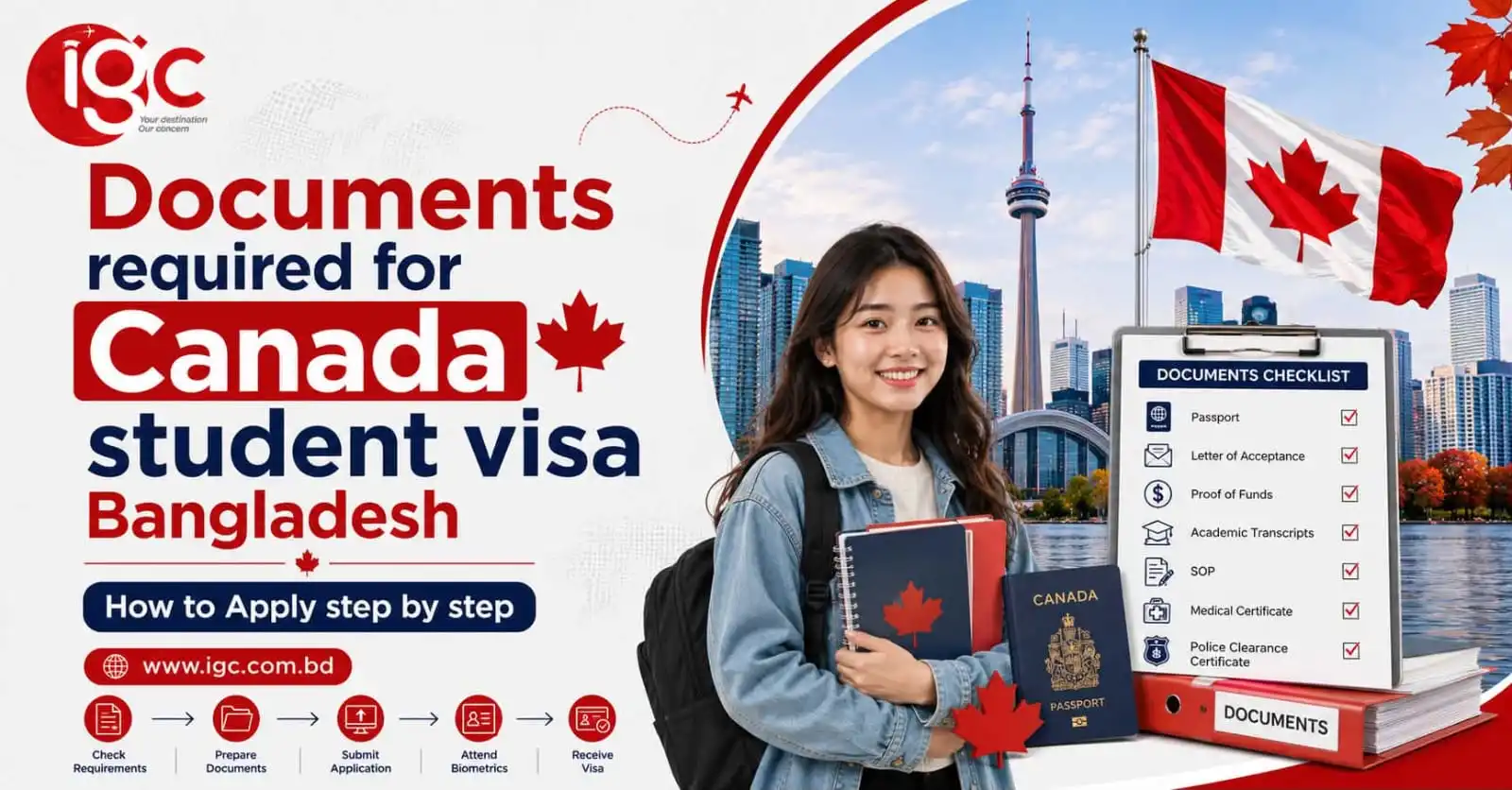
However, the main documents normally include:
The official Canadian application package for Bangladesh includes the study permit document checklist IMM 5483, visa office instructions IMM 5850, application form IMM 1294, family information form IMM 5707, and other situation-specific forms.
The safest approach is never to depend only on a general online checklist. Applicants should follow the personalised document list generated by their IRCC online account and check the specific instructions for Bangladesh.
Step 1: Select a Designated Learning Institution
Before thinking about a study permit, a student must first choose an eligible Canadian educational institution.
For post-secondary study, the school must normally appear on Canada's Designated Learning Institution list. If a post-secondary institution is not on the DLI list, a student generally cannot use admission from that school as the basis for a study permit application.
Let us consider the hypothetical example of Rafi, a student from Mirpur, Dhaka.
Rafi receives promotional messages from several foreign colleges. One offers fast admission and a large scholarship. Instead of paying immediately, he checks the official DLI list. This simple verification protects him from making a potentially costly mistake.
Bangladeshi students should check:
University selection should never be based only on an attractive advertisement.
Step 2: Obtain the Letter of Acceptance
The Letter of Acceptance, commonly called the LOA, is one of the most important documents required for Canada student visa Bangladesh applicants.
IRCC states that the school provides the LOA and that applicants upload it with the online application. For post-secondary applicants, the institution may also be asked to verify that the acceptance letter is genuine.
The letter normally identifies important information about the student and program, such as:
Applicants should carefully compare the information on the LOA with their passport and application forms.
Even a simple spelling difference should be investigated rather than ignored.
Step 3: Get a PAL, TAL, or CAQ if Required
Most study permit applicants need a Provincial Attestation Letter or Territorial Attestation Letter, commonly called a PAL or TAL. IRCC explains that in many cases the student must accept the offer and make a partial or full tuition payment before the school can help obtain this document.
There are important exemptions.
From January 1, 2026, students applying to degree-granting master's or doctoral programs at public DLIs do not generally need to provide a PAL or TAL.
Students going to Quebec follow a separate provincial process and normally need a Quebec Acceptance Certificate, or CAQ.
This is an area where students should be very careful because policies can change.
Do not assume that advice received by a friend two years ago is still correct today.
Step 4: Prepare a Valid Passport and Identity Documents
Proof of identity is always required.
For an online study permit application, IRCC instructs applicants to upload the information page of a valid passport or travel document. If the application is approved, the original passport may later be requested.
The Bangladesh-specific application instructions also refer to passport evidence and copies of relevant passport pages containing visas, stamps, and biographical information.
A student should check:
A study permit cannot be issued beyond the validity of the passport, so passport expiry should be considered early in the process.
Documents Required for Canada Student Visa Bangladesh: How to Apply Step by Step and Financial Evidence
Financial documentation is one of the areas that causes the greatest stress for Bangladeshi families.
IRCC requires students to prove that they have enough money, without depending on employment in Canada, to cover tuition, living expenses, and transportation for themselves and accompanying family members. For programs lasting more than one year, applicants must demonstrate funds for the first year and explain how they intend to finance the remaining period.
For applications submitted on or after September 1, 2025, a single applicant studying outside Quebec must show CAD 22,895 for first-year living expenses, excluding tuition and transportation. The amount increases when accompanying family members are included.
This means a student should not calculate:
What Financial Documents Can Be Used?
IRCC gives examples of common financial evidence, including:
Applicants do not necessarily need every item on this list. The purpose is to show genuine, available, understandable, and sufficient funding.
For Bangladeshi applicants, the financial story should make sense.
Suppose Samira's father earns BDT 120,000 per month, but a very large unexplained amount suddenly appears in his bank account seven days before the application.
The problem is not simply the existence of money. The important question becomes: Where did the money come from?
If it came from the legitimate sale of property, business income, a fixed deposit, or another lawful source, evidence should clearly explain that source.
The stronger approach is transparency, not artificial appearance.
Step 5: Write a Strong Study Plan or Letter of Explanation
IRCC recommends a letter of explanation in which applicants explain why they want to study in Canada and demonstrate that they understand their responsibilities as international students.
The Bangladesh application package also links to the visa office instructions for study permit applications, and those instructions may request a study plan.
A strong study plan should answer practical questions such as:
The purpose is not to write an emotional life story filled with dramatic statements. The study plan should be logical and supported by facts.
The Story of Mahmud: Explaining an Academic Change Honestly
Consider Mahmud, a hypothetical student from Chattogram.
He studied civil engineering but later worked for three years in project management. He then applied for a master's program in construction management in Canada.
At first, he worried that changing from pure engineering to management would look inconsistent.
Instead of hiding the change, he explained it.
His professional experience had shown him that technical knowledge alone was not enough for the type of leadership role he wanted. His new degree built directly on his past education and work experience.
This is good academic progression because the story has a logical connection.
Students should never invent false experience to make their study plan sound stronger. Honest explanation is far safer and more credible.
Step 6: Organise Academic and English-Language Documents
Academic documents may include:
The exact documents depend on the student's level of study and personal history.
The key is consistency.
If a student completed a bachelor's degree in 2022 and remained unemployed until 2025, that gap should not be hidden. It may require an honest explanation.
A gap itself is not automatically a problem. An unexplained or contradictory history is more concerning.
Step 7: Complete the Online Application Forms
To understand how to apply for Canada student visa from Bangladesh step by step, students should pay careful attention to forms.
For applicants in Bangladesh, the official application package identifies IMM 1294 as the Application for a Study Permit Made Outside Canada. Other forms may apply depending on family circumstances, use of a representative, common-law status, or custodianship of a minor.
The most important rule is simple:
Documents Required for Canada Student Visa Bangladesh: How to Apply Step by Step for Medical Examinations
Some study permit applicants need an immigration medical examination.
IRCC states that a medical examination may be required when a student plans to stay in Canada for more than six months, has recently spent time in certain countries, or intends to work in occupations where public health protection is important.
Only an approved panel physician can perform an immigration medical examination for IRCC purposes. A family doctor cannot do it unless that physician is officially on the approved panel list.
Bangladeshi students should therefore use the official panel physician information rather than selecting a clinic based only on advertisements.
Medical examination results are generally valid for 12 months and, when required for entry, must still be valid when the student arrives in Canada.
Step 8: Pay the Fees and Submit the Application
The current study permit processing fee is CAD 150. Biometrics may also be required and involve a separate fee.
Applications are generally submitted online.
Before pressing the final submission button, review:
A rushed application can lead to missing or contradictory information.
The objective should not be to apply as quickly as possible. The objective should be to submit a complete and truthful application.
Step 9: Give Biometrics When Instructed
Step 10: Wait for the Decision and Respond to Requests
After submission, IRCC may:
Processing time varies by country and circumstances. IRCC specifically notes that processing times may vary between visa offices.
Students should regularly check the online account and email.
Ignoring a document request or missing a deadline can damage an otherwise genuine application.
Documents Required for Canada Student Visa Bangladesh: How to Apply Step by Step and Common Bangladeshi Challenges
Financial Pressure
For many Bangladeshi families, overseas study represents years of savings.
The student may feel guilty about spending family money. Parents may consider selling property or borrowing heavily.
The practical advice is simple: calculate the complete first-year cost honestly and make a longer-term plan for the full course.
Do not assume part-time work will finance tuition.
IRCC requires evidence that sufficient money is available without relying on employment in Canada.
Academic Gaps
Many students worry about gaps caused by employment, business, health, family responsibilities, exam preparation, or personal circumstances.
A gap should be explained honestly and supported where possible.
Cultural Adjustment
A Bangladeshi student entering Canada may face unfamiliar classroom styles, different accents, independent learning, cold weather, multicultural social environments, and homesickness.
Preparing emotionally is as important as preparing documents.
Family Expectations
Some students are under enormous pressure to succeed because relatives view foreign education as a guaranteed path to wealth.
It is not.
International education requires academic effort, financial discipline, adaptability, and patience.
A realistic family discussion before departure can prevent many misunderstandings later.
The Story of Nusrat: How Organisation Reduced Her Stress
Nusrat, a hypothetical applicant from Sylhet, wanted to study data analytics in Canada.
Initially, she collected documents randomly. Bank statements were in one folder. Academic transcripts were in another. Her study plan had three different versions.
This small example captures an important truth about Documents Required for Canada Student Visa Bangladesh. A strong application is not created through panic. It is built through careful organisation and honest evidence.
Common Mistakes to Avoid
Most importantly, remember that you are responsible for the information submitted in your name.
Summary
The documents required for Canada student visa Bangladesh applicants normally include a valid passport, Letter of Acceptance, PAL or TAL when applicable, proof of funds, academic documents, application forms, a study plan, and situation-specific medical, police, or family documents. Understanding how to apply for Canada student visa from Bangladesh step by step means building a truthful, consistent, financially credible, and carefully organised application rather than simply collecting papers.
Frequently Asked Questions
4. Can my parents sponsor my studies in Canada?
11. Can I use an education loan as proof of funds?
Final Thoughts
Documents Required for Canada Student Visa Bangladesh is ultimately not only a document checklist. It is a complete story about a student's academic purpose, financial capacity, educational background, and future direction.
A successful application is not made stronger by adding unnecessary documents. It becomes stronger when the right documents support a clear, honest, and logical case.
For Bangladeshi students, the process can feel financially and emotionally overwhelming. Parents may be anxious. Students may fear mistakes. Friends may offer conflicting advice. Social media may create even more confusion.
The best response is careful preparation.
Verify the institution. Understand the program. Organise the finances. Write honestly. Check the latest rules. Read every document before submission.