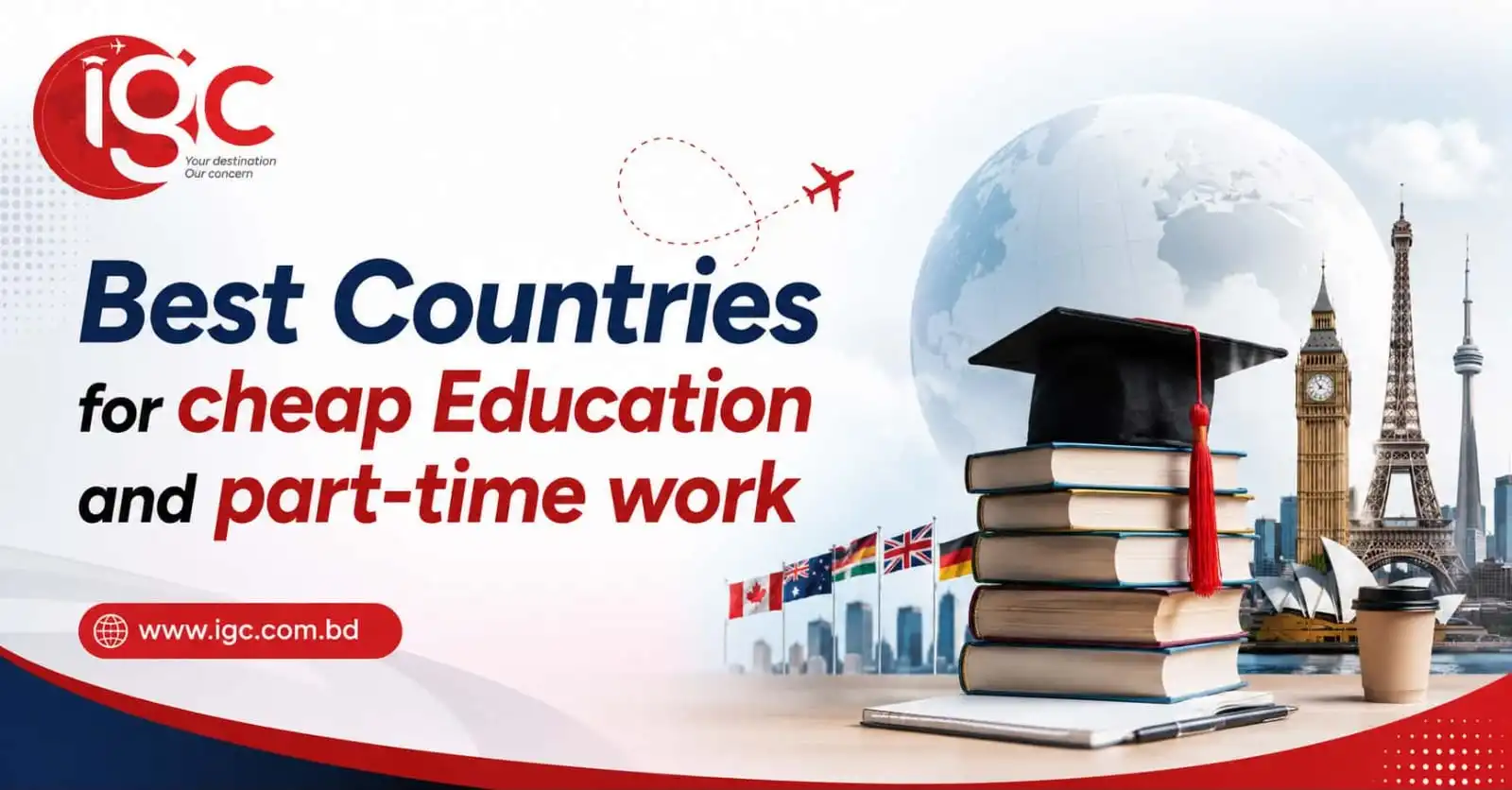
Choosing a foreign country for higher education is not only an academic decision. It is also a financial, social, and personal decision. This is especially true for students from Bangladesh. Many families use years of savings, sell land, take loans, or depend on relatives to support one student abroad. For this reason, finding the Best countries for cheap education and part-time work has become a serious concern for Bangladeshi students.
A country may offer low tuition fees but have very high living costs. Another country may allow students to work, but local language barriers may make finding a job difficult. Some destinations provide scholarships, affordable public universities, and legal part-time employment. However, students must still pay for accommodation, insurance, food, transport, visa processing, and emergency needs.
Therefore, cheap education should not mean only low tuition. It should mean a manageable total cost, reasonable work opportunities, good education, personal safety, and a realistic future after graduation. Part-time employment should also be viewed carefully. It can support food, transport, and some monthly expenses, but it should not be treated as a guaranteed source for paying full tuition.
The purpose is not to declare one perfect country for everyone. The goal is to help each student understand which destination matches their budget, academic background, language ability, career plan, and personal strength.
What Does Cheap Education Actually Mean?
Many students search for the lowest tuition fee and stop there. This is a mistake. The real cost of studying abroad has several parts:
For example, a university may charge only a small semester fee, but the student may need a large amount of money as proof of financial ability. Another university may provide a scholarship, but the city may have expensive rent and limited student housing.
When considering the cheap education and part-time work, calculate the total cost for at least one full academic year. Do not compare countries only by looking at one attractive tuition figure shown in an advertisement.
Part-time work must also be treated as additional support, not as the main financial plan. Jobs are not automatically available after arrival. Students may need several weeks or months to find suitable employment. During this time, rent and food expenses continue.
1. Germany: Strong Value Through Public Education
Germany remains one of the most attractive destinations for affordable higher education. Most students at public higher education institutions do not pay general tuition fees, although semester contributions and programme-specific charges may apply. Some states and individual universities may also charge tuition to non-European students. Semester contributions commonly cover administrative services, student facilities, and sometimes transport benefits.
International students from non-European countries may generally work up to 140 full days or 280 half-days in a year. Another available calculation allows eligible students to work up to 20 hours per week during the lecture period.
Why Germany Attracts Bangladeshi Students
Germany offers respected degrees in engineering, computer science, renewable energy, business, data science, and applied sciences. Many master’s programmes are taught in English. Public transportation is organised, and students may receive useful discounts.
Imagine Rahim, an electrical engineering graduate from Chattogram. He received admission to a public university in a smaller German city. He selected the city because rent was lower than in Munich or Frankfurt. During his first semester, he focused on learning basic German and adjusting to the academic system. Later, he found a part-time warehouse job and then moved to a student assistant position related to his department.
Rahim’s success did not come only from receiving admission. He planned his finances, learned the local language, accepted a simple first job, and slowly built professional contacts.
Main Challenges in Germany
The largest challenge is often the initial financial proof required for the visa. Accommodation shortages can also be serious in popular cities. German language ability is very important for many customer service, retail, office, and technical jobs.
Students should also understand that tuition-free education does not mean cost-free education. Rent, health insurance, food, and transport may still create a heavy monthly burden.
Best For
Germany is highly suitable for students who:
2. France: Affordable Public Study with Wider Cultural Exposure
France can be a practical destination for students who carefully select a public institution and avoid the most expensive parts of Paris. International students with the proper residence status may work up to 964 hours per year. This is equal to about 60 percent of the standard annual working limit. French student employment should still be treated as extra income rather than full financial support.
France has strong programmes in business, fashion, hospitality, engineering, public policy, arts, artificial intelligence, and social sciences. Some programmes are taught in English, especially at the master’s level.
A Bangladeshi Student’s Possible Journey
Nusrat, a business graduate from Dhaka, wanted to study international management. She initially focused only on English-taught programmes. However, she started learning French six months before travelling. Her basic language ability helped her communicate with landlords, understand transport systems, and later obtain a part-time café job.
At first, she struggled with fast French conversations and unfamiliar food habits. She began cooking with two other Bangladeshi students and reduced her monthly food cost. She also joined an international student group, which helped her avoid loneliness.
Practical Advantages
France provides a rich academic and cultural experience. Students can meet people from Africa, Asia, Europe, and the Middle East. Public transportation is strong in major cities, and many institutions support international student integration.
Main Difficulties
French language skills are often necessary for finding part-time employment. Housing in Paris can be extremely expensive. Administrative paperwork may also feel slow and complex.
Students with limited budgets should explore cities such as Lille, Poitiers, Limoges, Clermont-Ferrand, or other regional locations instead of immediately choosing central Paris.
3. Italy: Scholarships, Public Universities, and Regional Support
Italy is frequently included among the Best countries for cheap education and part-time work because many public universities offer reasonable tuition structures. Fees may depend on the university, programme, family income rules, and scholarship status.
Italy is particularly attractive because of regional scholarships. Depending on eligibility, some scholarships may reduce tuition and support accommodation, meals, or living costs. However, students must carefully prepare income and family documents in Bangladesh. These documents may require translation, legalisation, certification, or other formal processing.
Story of a Student Who Prepared Early
Consider Tanvir, a student from Rajshahi who wanted to study architecture. He learned about an Italian regional scholarship but discovered that the financial documents were complicated. Instead of waiting until the last month, he collected family income certificates, property information, academic records, and translations early.
After arriving in Italy, he faced difficulty understanding local office procedures. A senior Bangladeshi student helped him book appointments and prepare forms. Tanvir later found weekend work in a restaurant, but he continued learning Italian because English alone was not enough for daily life.
Why Italy Can Be Affordable
Italian public universities may offer lower tuition than many private institutions in English-speaking countries. Student housing services and university residences can sometimes be more affordable than the open rental market.
Cities outside Milan and central Rome may provide better financial value. Turin, Padua, Pavia, Pisa, Bari, and other university cities may be considered depending on the programme and available support.
Important Risks
Students should never assume that a scholarship is guaranteed before receiving official confirmation. Delayed scholarship payments can create financial pressure. Part-time jobs may also require Italian language skills.
Italy is a good choice for disciplined students who can manage documents carefully and remain patient with administrative systems.
4. Hungary: Affordable European Degrees and Scholarship Opportunities
Hungary offers relatively affordable programmes compared with many Western European destinations. Tuition varies by subject and institution. Business programmes may cost far less than medical programmes, while medicine and dentistry can remain expensive. Official study information notes that tuition fees depend greatly on the chosen university and programme.
Non-European students holding the proper study residence permit may work up to 30 hours per week during the study period. They may also work for a limited number of days outside the study period under the applicable rules.
Why Hungary Appeals to Bangladeshis
Hungary offers English-taught courses in engineering, agriculture, economics, medicine, computer science, and social sciences. The Stipendium Hungaricum scholarship is also well known among Bangladeshi applicants.
Suppose Farzana from Sylhet receives a partial tuition scholarship instead of full funding. She chooses a shared room in a student residence and uses public transport. During the first semester, she works only a few hours because her course is demanding. In the second semester, she begins assisting at a small international office.
Her experience teaches an important lesson. The legal right to work does not mean that a student should work the maximum number of hours. Academic progress must remain the main priority.
Common Problems
Hungarian is a difficult language for many newcomers. English-speaking jobs may be concentrated in Budapest, where rent is usually higher. Students in smaller cities may enjoy lower expenses but face fewer employment options.
Hungary is suitable for students who find a strong scholarship or a reasonably priced programme and can maintain a careful monthly budget.
5. Poland: Lower Costs with a Growing International Education Market
Poland has become popular among international students because of its European location, expanding English-taught programmes, and relatively moderate living expenses compared with some Western European countries.
Tuition costs vary widely. Public education is not automatically free for all non-European students, so applicants must inspect the exact fee structure of each programme. Business, information technology, logistics, engineering, and management are common areas of interest.
A Realistic Student Scenario
Arif from Cumilla chooses a university in a Polish city outside Warsaw. He avoids a private single room and shares an apartment with three students. He carries enough money for several months rather than expecting immediate employment.
After arrival, he applies for jobs in food delivery, warehouses, customer support, and university services. He receives several rejections because he does not speak Polish. Instead of becoming discouraged, he takes a beginner language course and continues applying.
After four months, he finds a weekend logistics job. The income helps with groceries and transportation, but it does not cover all of his tuition.
Why Poland May Work
Poland can offer a balance between European education and manageable daily expenses. However, the quality and international recognition of institutions can differ. Applicants should examine accreditation, programme content, graduate outcomes, and university reputation.
Students should be careful about agents who promise guaranteed jobs, permanent residence, or very high earnings. No honest adviser can guarantee these outcomes.
6. Finland: High-Quality Education but Not Always Cheap Without a Scholarship
Finland is academically excellent, safe, organised, and highly respected. However, it should not automatically be described as a low-cost destination for non-European students.
Official guidance states that tuition for English-taught bachelor’s and master’s programmes commonly ranges from about 8,000 to 20,000 euros per year. Estimated living costs may be around 900 to 1,200 euros per month. International students may generally work an average of up to 30 hours per week during the academic year and full-time during holidays. Finland also clearly warns that part-time earnings may not cover both tuition and living costs.
When Finland Becomes Affordable
Finland becomes a realistic option when a student receives a major tuition scholarship. Some universities offer partial or full tuition reductions based on academic merit.
For example, Mehedi, a software engineering applicant from Dhaka, receives a 75 percent tuition waiver. He still prepares funds for rent, insurance, food, winter clothing, and transportation. He learns basic Finnish, but his first job search is difficult. He finally finds a university project assistant role because of his programming skills.
His case shows that technical ability can sometimes be more useful than depending only on general part-time jobs.
Best Strategy for Finland
Students should build employable skills before arrival. Programming, graphic design, data analysis, restaurant experience, cleaning experience, digital marketing, and customer support skills may improve job prospects.
Finland is best for academically strong students who secure scholarships and do not depend on uncertain employment.
7. Malaysia: Affordable Living but Limited Student Work Rights
Malaysia is geographically closer to Bangladesh than Europe. Flights may be cheaper, food may feel more familiar, and the climate is easier for many Bangladeshi students. Malaysia is also recognised as relatively affordable in tuition, housing, food, and transportation.
However, the work rules are more limited than many students expect. International students may generally work up to 20 hours per week only during semester breaks or holidays longer than seven days. Prior immigration approval is required, and employment is limited to specified sectors and workplaces.
Why Malaysia Still Makes Sense
Malaysia can be suitable for students whose families can support most of the study cost. It is not ideal for those who must earn regular income every month during classes.
Shafiq from Narayanganj chooses Malaysia for a computing degree. His family can pay the tuition but wants him to control living expenses. He stays in shared housing, cooks most meals, and uses student transportation. During an approved semester break, he finds permitted part-time work.
His financial success comes mainly from low-cost living, not from continuous employment.
Main Advice
Students should not travel to Malaysia believing they can legally work throughout every academic week. They must follow the conditions of the student pass and obtain proper approval.
Malaysia may be one of the Best countries for cheap education only for students who understand that the work opportunity is restricted.
8. Japan: Strong Work Culture with Language Demands
Japan offers respected education, advanced technology, safe cities, and strong programmes in engineering, robotics, business, and science. Tuition at national and public institutions may be lower than at many private universities in Western countries, although total costs still depend on the city and programme.
International students may be allowed to work part-time after receiving the required permission. Job opportunities may include restaurants, convenience stores, factories, language support, delivery services, and campus work.
A Bangladeshi Student’s Adjustment
Rafi, a mechanical engineering student from Gazipur, learns basic Japanese before travelling. At first, he is surprised by strict punctuality, formal communication, and workplace discipline. He makes small mistakes but listens carefully to his supervisor.
Within several months, his language improves. He obtains a better part-time position in a technical workshop. His experience shows that students who respect Japanese work culture and learn the language can improve their opportunities.
Important Challenges
Japanese language ability is a major factor. Students must also manage academic pressure and long commuting times. Tokyo can be expensive, while regional cities may be more affordable.
Japan is not necessarily the cheapest option in every case, but scholarships, public institutions, and careful city selection can make it manageable.
How to Compare the Best Countries for Cheap Education and Part-Time Work
Students should create a comparison sheet before applying. Include the following points for every country:
Give each point a score from one to five. This creates a more honest comparison than emotional decisions based on social media videos.
Special Challenges Faced by Bangladeshi Students
Financial Pressure
Many Bangladeshi families expect students to begin earning immediately. This pressure can damage academic performance. A student may work late at night and then miss morning classes.
The solution is to arrange enough money for at least the early months. Families should prepare a written budget and maintain an emergency reserve.
Currency Changes
The value of the Bangladeshi taka may change against the euro, dollar, yen, or other currencies. A tuition fee that looks manageable today may become more expensive later.
Students should add a safety margin to their budgets rather than calculating the exact minimum amount.
Cultural Differences
Students may face direct communication, individual lifestyles, mixed-gender housing, unfamiliar food, cold weather, and different religious environments.
Joining Bangladeshi groups can provide comfort, but students should also build friendships with local and international classmates. Integration improves language ability, confidence, and job opportunities.
Homesickness and Mental Stress
Living abroad can feel exciting during the first weeks. Later, loneliness and financial anxiety may appear.
Regular communication with family is helpful, but students should not hide serious problems. University counselling, international offices, classmates, and community organisations may provide support.
Dependence on Agents
Some students allow an agent to control every step. They may not even understand their programme, visa conditions, or tuition refund policy.
Students must personally read their offer letter, payment schedule, work rules, course modules, and refund conditions. An agent can support the process, but the student remains responsible.
Which Country Is Best for Which Type of Student?
Germany may be best for technically strong students who can arrange initial funds and learn German.
Italy may suit students seeking regional scholarships and lower public university fees.
Hungary may be useful for scholarship applicants and students seeking English-taught European programmes.
France can benefit students willing to learn French and study outside expensive central areas.
Poland may attract students seeking moderate costs and growing English-medium options.
Finland is stronger for scholarship recipients with good academic or technical skills.
Malaysia is practical for students who want lower living costs and have family funding.
Japan may suit disciplined students interested in technology who are willing to learn Japanese.
This is why the Best countries for cheap education and part-time work will not be identical for every Bangladeshi applicant.
Practical Application Plan for Bangladeshi Students
Start preparation at least one year before the intended intake.
First, identify the subject and career goal. Then shortlist five to eight recognised universities. Compare tuition, living costs, scholarship deadlines, academic entry requirements, and legal work rules.
Prepare academic transcripts, certificates, passport, English test results, recommendation letters, statement of purpose, financial papers, and translations early.
Apply directly through official university systems whenever possible. Keep copies of every submitted document and payment receipt.
Before travelling, learn basic cooking, budgeting, public transport use, workplace communication, and the local language. These simple skills can save money and reduce stress.
Most importantly, never make a plan that depends entirely on part-time income.
Summary
The Best countries for cheap education and part-time work include Germany, France, Italy, Hungary, Poland, Finland, Malaysia, and Japan, but each offers a different balance of tuition, living costs, scholarships, language needs, and employment rights. Bangladeshi students should compare total expenses rather than tuition alone. Part-time work can support daily costs, but it should never replace proper financial preparation.
Frequently Asked Questions
1. Which country is the cheapest for a Bangladeshi student?
2. Can part-time work pay my full tuition abroad?
3. Is Germany completely free for international students?
4. Can I study abroad if my family has a limited income?
5. Which country offers the best scholarship opportunities?
6. Do I need to learn the local language?
7. Which country is best for engineering students?
8. Is Malaysia a good country for students who need to work?
9. Is Finland affordable for Bangladeshi students?
10. How much money should I carry for the first months?
11. Should I choose a capital city or a smaller city?
12. Can a low academic result still lead to admission?
13. How can I avoid dishonest education agents?
14. What skills help students find part-time work?
15. What is the safest final strategy for choosing a country?