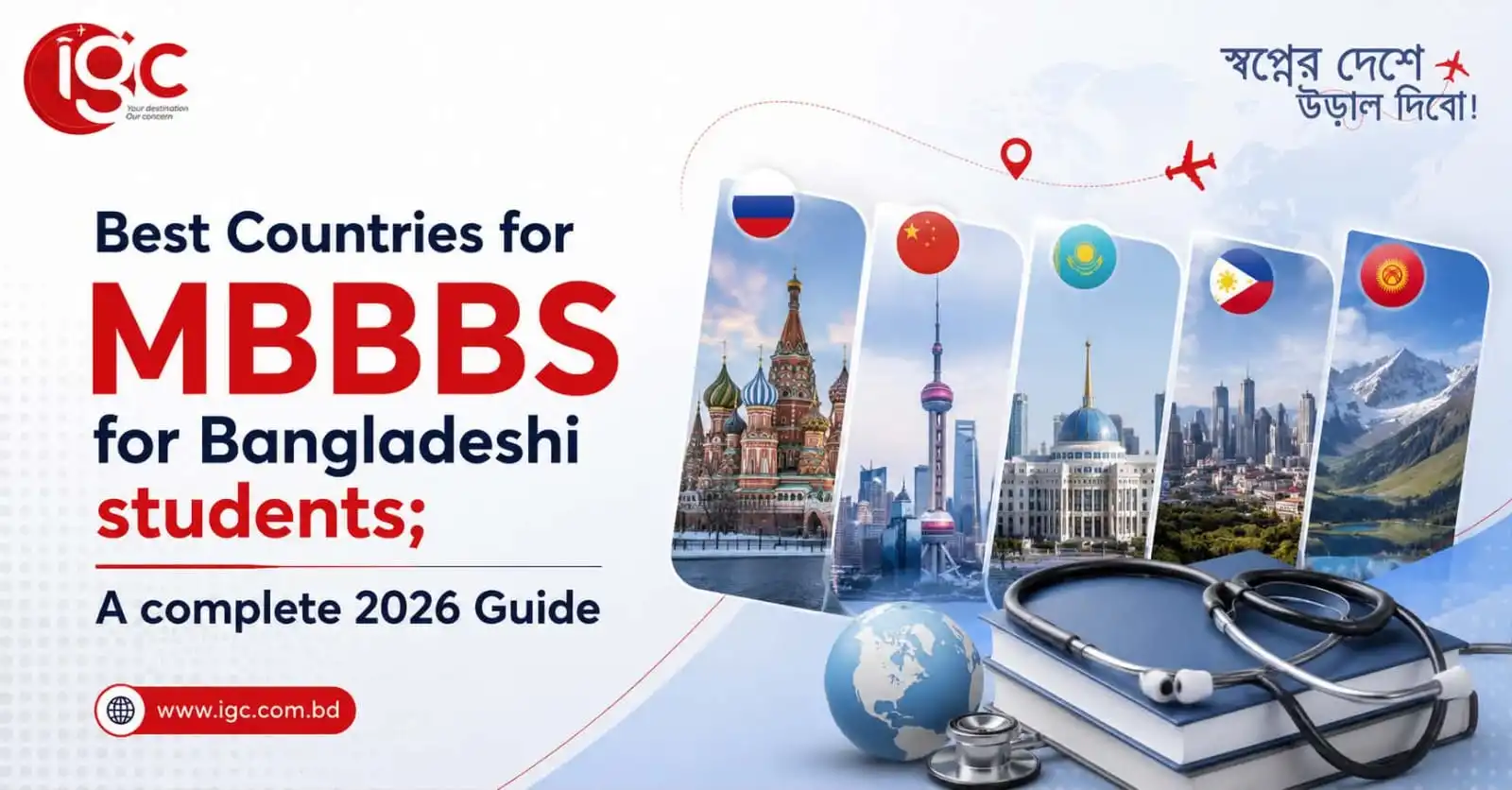
Best Countries for MBBS for Bangladeshi Students: A Complete 2026 Guide
Choosing where to study medicine is one of the biggest decisions in a student’s life. It is not only about selecting a university or getting an admission letter. It is also about choosing a country where the degree will be useful, the education will be reliable, the total cost will be manageable, and the student will feel safe and supported. For this reason, searching for the Best countries for MBBS for Bangladeshi students requires careful research rather than depending only on advertisements from education agencies.
Every year, many Bangladeshi students wish to become doctors. However, the number of medical seats in Bangladesh is limited, and admission competition is very high. Private medical education may also be expensive for middle-income families. As a result, many students begin exploring MBBS abroad for Bangladeshi students. Countries such as China, Russia, Kyrgyzstan, Kazakhstan, Georgia, Nepal, Malaysia, India, Uzbekistan, and the Philippines often appear in their searches.
Still, the lowest tuition fee does not always mean the best medical education. A student must consider university recognition, course duration, teaching language, hospital exposure, internship conditions, climate, food, visa rules, safety, and the process of returning to Bangladesh for professional registration.
Why Bangladeshi Students Consider Studying MBBS Abroad
The dream of becoming a doctor remains strong in Bangladesh. Thousands of students complete HSC every year with science backgrounds and prepare for medical admission. However, only a part of them receive places in government medical colleges.
A student may have excellent SSC and HSC results but still miss a government seat because of intense competition. Private medical colleges provide another route, but the total cost may be difficult for many families.
This is where MBBS abroad for Bangladeshi students becomes attractive.
Students commonly consider foreign medical education because of:
- More available medical seats
- Lower admission competition in some countries
- Affordable tuition at selected public universities
- International student communities
- English-medium programmes
- Modern laboratories and teaching hospitals
- Opportunities to experience a different healthcare system
- Possible pathways to postgraduate study in other countries
However, studying abroad is not an automatic shortcut. Medical education remains difficult everywhere. A student must study anatomy, physiology, pathology, pharmacology, medicine, surgery, and many other subjects. The student must also communicate with patients during clinical training.
The Most Important Requirement: Recognition and Registration
Before comparing countries, students must understand one critical point. A university’s international advertisement does not prove that its degree will be accepted in Bangladesh.
The Bangladesh Medical and Dental Council is responsible for setting standards and managing the registration of medical practitioners in Bangladesh. BMDC has also issued notices concerning eligibility certificates for students planning to study medicine abroad. In April 2026, BMDC published results for a Registration Qualifying Examination for foreign medical graduates, showing that returning graduates may need to complete formal assessment requirements before professional registration.
Students should verify:
- Whether they meet the academic eligibility requirements before departure
- Whether an eligibility certificate is required
- Whether the university is officially recognised in its own country
- Whether the medical programme permits professional registration there
- Whether the programme includes acceptable clinical training
- Whether the internship structure satisfies relevant requirements
- Whether the student will be eligible for the required examination after returning to Bangladesh
The World Directory of Medical Schools is a useful research tool, but students must understand its limitation. The directory itself clearly explains that listing a medical school does not automatically mean recognition, accreditation, or approval.
Therefore, never accept the statement, “This university is listed, so there will be no registration problem,” without further verification.
How to Identify the Best Countries for MBBS for Bangladeshi Students
A country should not be ranked only by tuition fees. A proper comparison should examine several connected factors.
Academic Quality
Look at the curriculum, teaching hospitals, laboratories, faculty qualifications, patient exposure, examination system, and student support.
Total Cost
Calculate tuition, hostel fees, food, transportation, insurance, visa renewal, airfare, winter clothing, books, laboratory charges, and emergency expenses.
Teaching Language
Some universities advertise an English-medium programme but use the local language during hospital training. Students must confirm how much of the programme is truly taught in English.
Clinical Exposure
A medical student cannot learn everything from books. Real patients, supervised hospital duties, clinical discussions, and practical examinations are essential.
Cultural Adjustment
Food, religion, social behaviour, weather, language, and daily routines can affect a student’s mental health and academic performance.
Career Recognition
Students should think about where they want to work after graduation. A degree that supports registration in Bangladesh may not automatically provide registration in the United Kingdom, United States, Australia, or another country. For example, the UK General Medical Council separately examines whether an overseas primary medical qualification is acceptable.
1. China
China is often considered one of the Best countries for MBBS for Bangladeshi students because it offers many established universities, modern cities, strong transport systems, and large teaching hospitals.
Medical programmes commonly last around six years, although the exact structure depends on the university. Some programmes include classroom study, laboratory training, clinical rotations, and internship.
Why China Is Popular
- Geographically closer to Bangladesh than many European destinations
- Large number of public universities
- Modern laboratories and university hospitals
- English-taught programmes at approved institutions
- Strong campus infrastructure
- Large international student population
- Availability of halal food in many university cities
Important Challenges
The main challenge is language. Even when classroom teaching is in English, students may need Mandarin to communicate with local patients. Clinical learning can become weak when students cannot understand patients or hospital staff.
Bangladeshi applicants must also ensure that the university is officially authorised to teach the English-medium medical programme to international students. Published information for recent intakes indicates that China limits English-medium international MBBS recruitment to approved institutions rather than allowing every medical university to offer the programme.
Approximate Cost
Depending on the university and city, annual tuition may fall within a moderate range compared with Western medical schools. Accommodation and living costs vary greatly between smaller cities and major centres such as Beijing, Shanghai, or Guangzhou.
A Student Story
Consider the hypothetical example of Farhana from Cumilla. She selected a university in China mainly because the tuition was affordable. During her first year, she performed well in basic science subjects. However, when clinical training started, she struggled to communicate with patients.
Instead of ignoring the problem, she joined a Mandarin language class, practised with local students, and learned common medical questions. By her fourth year, she could collect basic patient histories under supervision. Her experience shows that English-medium admission alone is not enough. Language preparation directly affects clinical confidence.
2. Russia
Russia has hosted international medical students for many years. It is frequently included in discussions about MBBS abroad for Bangladeshi students because several state universities offer medicine at comparatively affordable fees.
General medicine programmes are often six years long. Fees differ significantly among universities. Published 2025 and 2026 information shows that some Russian medical programmes may begin near a few thousand US dollars per year, while well-known institutions in major cities may charge much more.
Main Advantages
- Long history of medical education
- Several state-funded or public universities
- Comparatively affordable programmes outside major cities
- Established international student communities
- Strong teaching in basic medical sciences
- Availability of university dormitories
Main Challenges
Russian winters can be difficult for Bangladeshi students. Temperatures may remain below freezing for long periods. Students must budget for winter clothing, heating-related costs, and local transportation.
Russian language is also important during clinical practice. A student may attend English lectures but still need Russian to speak with patients and hospital workers.
Political and travel conditions should be reviewed before admission. Flight routes, banking systems, currency exchange, and international payment options may change. Families should examine these matters instead of assuming that conditions will remain stable for six years.
A Practical Lesson
Rafi, a hypothetical student from Bogura, chose a lower-cost Russian university. His family calculated only tuition and hostel fees. They did not include winter clothing, document translation, visa renewal, medical insurance, food, and annual travel.
By the second year, the family faced financial pressure. Rafi later created a yearly budget with a 15 percent emergency reserve. The lesson is important. An affordable tuition fee does not always mean an affordable total education.
3. Kyrgyzstan
Kyrgyzstan is another popular destination because of its comparatively low fees and relatively simple admission process at many institutions.
For families with strict financial limits, it may appear to be one of the Best countries for MBBS for Bangladeshi students. However, the quality of institutions can vary. Students should not judge the whole country through the reputation of one university.
Possible Benefits
- Lower tuition at many institutions
- Lower living costs than several European countries
- International student communities
- Availability of English-medium programmes
- Familiar South Asian food near some campuses
Possible Risks
Some students report differences between promised facilities and actual facilities. A university may advertise modern hospitals, international faculty, or extensive patient exposure, but the daily learning environment may be different.
Students should ask for:
- Current videos of laboratories and classrooms
- Names and addresses of teaching hospitals
- Actual weekly clinical schedules
- Written fee structures
- Internship details
- Contact information for current Bangladeshi students
- Information about local accreditation
Kyrgyzstan may work well for a disciplined and independent student. It can be risky for someone who depends completely on an agent and does not verify information.
4. Kazakhstan
Kazakhstan has become more visible among international medical applicants. It offers several medical universities, developing cities, and comparatively affordable living costs.
Why Students Consider Kazakhstan
- Moderate tuition fees
- Several established public universities
- English-taught medical programmes
- Multicultural student groups
- Improving educational infrastructure
- Reasonable accommodation costs in some cities
Challenges to Consider
Students may need Russian or Kazakh for clinical communication. Weather can also be much colder than Bangladesh. Long-distance travel and changing flight costs must be included in the budget.
The quality gap between universities is another concern. One institution may have strong hospitals and experienced teachers, while another may rely heavily on classroom lectures with limited practical exposure.
For this reason, MBBS abroad for Bangladeshi students in Kazakhstan should be based on university-level research rather than country-level reputation.
5. Georgia
Georgia has gained popularity because of its European environment, English-medium medical programmes, relatively modern cities, and international student population.
Key Advantages
- Many English-taught programmes
- European-style academic environment
- Modern private and public universities
- Relatively safe cities
- Increasing international enrolment
- Exposure to a multicultural community
Financial Reality
Georgia is generally more expensive than Kyrgyzstan or some Central Asian destinations. Tuition may be manageable for upper-middle-income families, but accommodation and food can increase the total cost.
Some programmes award an MD qualification rather than using the title MBBS. Students must not become confused by the name. They should investigate the programme level, duration, clinical content, local licensing status, and acceptability for their future registration route.
Clinical Language
Although classroom teaching may be in English, Georgian language knowledge can be necessary during hospital interaction. Students should confirm whether the university provides structured language classes.
6. Nepal
Nepal has a familiar South Asian culture and a healthcare environment that may feel more understandable to Bangladeshi students.
Its closeness, food habits, climate, and regional disease patterns can make adaptation easier. Clinical conditions in Nepal may also have similarities with those in Bangladesh.
Strong Points
- Cultural similarities
- Shorter travel distance
- Familiar food and social environment
- English commonly used in medical education
- Valuable exposure to South Asian health problems
- Easier family visits than distant destinations
Limitations
Medical tuition in Nepal may not always be cheap. Admission can be competitive, and some institutions may require entrance examinations or other eligibility procedures.
Therefore, Nepal may be one of the Best countries for MBBS for Bangladeshi who value cultural comfort and relevant clinical exposure, but it may not be the cheapest choice.
7. India
India has a large medical education system, major teaching hospitals, and disease patterns similar to Bangladesh.
Potential Advantages
- Strong clinical exposure at established colleges
- Similar cultural and dietary environment
- Easy regional travel
- English used in medical education
- Large patient populations
- Wide range of hospitals and specialties
Major Concerns
Admission requirements can be complex for international students. Fees differ widely. Government seats are highly competitive, while private or management-category education may be very expensive.
Students must verify the admission route, entrance examination conditions, tuition category, internship rules, and professional registration pathway before paying any money.
India can offer excellent education, but it is not automatically affordable.
8. Malaysia
Malaysia offers a comfortable living environment, strong infrastructure, English usage, halal food, and cultural diversity. Bangladeshi students may also find the Muslim-friendly environment reassuring.
Advantages
- English widely used
- Modern hospitals and campuses
- Halal food is easily available
- Comfortable social environment
- Strong transport and digital services
- Internationally connected universities
Disadvantages
The largest limitation is cost. Medical programmes in Malaysia can be significantly more expensive than programmes in Central Asia, China, or some Russian universities.
Malaysia may be suitable for families with higher budgets who want a modern and culturally comfortable environment. It is less suitable for students whose main priority is minimum cost.
9. Uzbekistan
Uzbekistan has recently attracted more South Asian medical students because of moderate fees and expanding English-medium programmes.
Possible Benefits
- Affordable tuition at selected institutions
- Moderate living expenses
- Growing international student population
- Public medical universities
- Cultural and religious familiarity in some areas
Areas Requiring Careful Checking
Rapid international recruitment can sometimes create quality-control concerns. Students should examine class size, faculty availability, teaching hospital access, language use, and the number of international students admitted each year.
Uzbekistan can be a practical choice, but students must avoid selecting a newly promoted programme without evidence of stable academic systems.
10. The Philippines
The Philippines is known for widespread English use and an education system influenced by the United States. However, its route to medical qualification can be structurally different from the standard South Asian MBBS model.
In some cases, students must complete pre-medical education before entering the main medical programme. This may increase the total duration and cost.
Advantages
- English widely spoken
- Strong communication-based learning
- Familiarity with US-style medical examinations
- Large clinical settings in major cities
Challenges
Students must understand the complete academic pathway. They should not assume that direct admission after HSC will follow the same structure as a six-year MBBS course elsewhere.
Before choosing the Philippines, applicants should confirm the pre-medical requirement, degree title, course duration, internship, local licensing conditions, and return-registration pathway.
Comparative View of Major Destinations
A simple comparison can help families create an initial shortlist.
Best for Lower Budgets
Kyrgyzstan, Uzbekistan, Kazakhstan, and selected Russian universities may offer comparatively affordable options. However, low price must be balanced with education quality and clinical exposure.
Best for Infrastructure
China, Malaysia, and established universities in Russia or Georgia often provide stronger campus infrastructure.
Best for Cultural Familiarity
Nepal, India, and Malaysia may be easier for food, religion, language use, and social adjustment.
Best for English Communication
Malaysia, the Philippines, Nepal, and many Indian institutions may provide easier English communication. However, local language may still matter in hospitals.
Best for Nearby Travel
India, Nepal, China, and Malaysia are generally more convenient than distant European or Central Asian locations.
This comparison shows why there is no universal answer to the question of the Best countries for MBBS for Bangladeshi students.
Common Challenges Faced by Bangladeshi Medical Students
Financial Pressure
Many families sell land, use retirement savings, or borrow money to fund medical education. This creates emotional pressure on the student.
A six-year plan should include:
- Tuition increases
- Hostel charges
- Food and transport
- Visa renewal
- Insurance
- Air tickets
- Books and equipment
- Language courses
- Examination fees
- Internship expenses
- Emergency medical costs
- Currency exchange changes
Families should keep an emergency reserve rather than using their entire savings for the first payment.
Cultural Differences
A student who has never lived outside Bangladesh may feel lonely. Food may taste different. Religious facilities may be far away. Local people may communicate in an unfamiliar way.
Joining student clubs, maintaining contact with family, learning the local language, cooking simple meals, and making friends from different countries can reduce isolation.
Academic Adjustment
Some students are used to memorising textbooks. Foreign universities may use presentations, oral examinations, group assignments, clinical demonstrations, and independent study.
Students should develop note-taking, communication, research, and time-management skills before departure.
Language Barriers
Local language skills can determine the quality of clinical learning. A student who cannot understand patients may pass written examinations but struggle in real hospital practice.
Start learning the language from the first semester. Do not wait until clinical rotations begin.
Agency-Related Problems
Admission agencies can be helpful, but students should never depend on verbal promises. Reports of overseas medical admission fraud show why families should confirm university fees and payment procedures directly rather than sending large sums through unverified intermediaries.
Keep copies of:
- Admission letter
- University invoice
- Payment receipt
- Passport
- Visa
- Contract
- Hostel confirmation
- Academic documents
- Communication with the university
Whenever possible, pay official fees directly to the university’s authorised account.
A Step-by-Step Selection Method
The safest way to choose MBBS abroad for Bangladeshi students is to follow a structured process.
Step 1: Confirm Eligibility in Bangladesh
Check academic requirements and complete any required eligibility process before admission.
Step 2: Set a Six-Year Budget
Do not prepare only a first-year budget. Calculate the possible total cost and include an emergency reserve.
Step 3: Select Three Countries
Choose one affordable option, one balanced option, and one higher-quality option.
Step 4: Compare Individual Universities
Examine accreditation, course duration, hospitals, student numbers, teaching language, internship, and graduate outcomes.
Step 5: Speak With Current Students
Talk to at least three students from different academic years. One agent-selected student is not enough.
Step 6: Verify All Fees
Ask for an official written fee schedule. Confirm whether tuition can increase.
Step 7: Check the Clinical Programme
Ask when hospital training begins, which hospitals are used, and how many students are placed in each clinical group.
Step 8: Review the Return Pathway
Understand what examinations, documents, internships, or registration steps may apply after graduation.
Step 9: Study the Contract
Check refund rules, transfer policies, hostel conditions, and consequences of academic failure.
Step 10: Make a Family Decision
The student and family should make the decision together. The final choice should not be controlled by an agency.
Final Verdict
China can provide strong infrastructure and large hospitals, but Mandarin is important. Russia may offer established universities and moderate costs, but climate and language require preparation. Kyrgyzstan, Kazakhstan, and Uzbekistan can be affordable, but university quality must be examined carefully. Georgia provides an attractive international environment but may cost more. Nepal and India offer cultural and clinical familiarity, although admission and tuition can be challenging. Malaysia offers comfort and English usage but requires a higher budget. The Philippines provides an English-speaking environment, but the course structure must be understood clearly.
The correct decision is not the cheapest country or the most famous country. It is the country and university combination that provides recognised education, real clinical training, financial stability, personal safety, and a realistic registration pathway.
Summary
Selecting among the Best countries for MBBS requires more than comparing tuition fees. Students must verify eligibility, accreditation, teaching language, clinical exposure, internship conditions, total cost, and registration requirements. China, Russia, Nepal, Georgia, Kazakhstan, Kyrgyzstan, Uzbekistan, India, Malaysia, and the Philippines all offer different benefits and risks. Careful university-level research, direct fee verification, and long-term financial planning can protect both the student’s career and the family’s investment.
Frequently Asked Questions
1. Which country is the cheapest for Bangladeshi students to study medicine?
- Kyrgyzstan, Uzbekistan, Kazakhstan, and some Russian universities are often among the lower-cost options.
- However, tuition is only one part of the total expense.
- Students must also calculate food, hostel charges, insurance, visas, flights, books, and internship costs.
- A very cheap university may provide limited hospital access or overcrowded classes.
- Families should compare the complete six-year expense rather than the first-year package.
- The safest low-cost choice is a properly accredited university with transparent fees and active teaching hospitals.
2. Is an MBBS degree from China accepted in Bangladesh?
- A Chinese medical degree may support a registration application when the student and programme satisfy the relevant conditions.
- However, acceptance should never be assumed only because the university is located in China.
- The applicant should verify the university’s official status and authority to teach international medical students.
- The student should also complete any required eligibility process before leaving Bangladesh.
- After graduation, document verification, examination, internship, or registration requirements may apply.
- Written confirmation from relevant authorities is safer than depending on an admission agent’s statement.
3. Do I need a BMDC eligibility certificate before studying abroad?
- Bangladeshi applicants should check the latest BMDC eligibility requirements before accepting foreign admission.
- Eligibility rules can involve academic results, science subjects, admission qualifications, and document verification.
- Students should complete the required process before paying a large non-refundable amount.
- Without proper eligibility, a graduate may face serious problems when returning to Bangladesh.
- An admission letter from a foreign university does not replace Bangladesh’s regulatory requirements.
- Applicants should preserve all original certificates, marksheets, notices, applications, and payment receipts.
4. Is Russia safe for Bangladeshi medical students?
- Safety can vary according to city, university, accommodation, travel conditions, and the wider political situation.
- Many international students continue to study in Russian universities, but applicants should make current assessments.
- They should review embassy guidance, transport routes, financial transaction systems, and local student experiences.
- Students should select official university accommodation during the first year where possible.
- Learning basic Russian and understanding local laws can reduce daily difficulties.
- Families should also prepare emergency contact plans and maintain enough funds for unexpected travel.
5. Can I study medicine abroad without learning the local language?
- A student may begin an English-medium programme without knowing the local language.
- However, clinical training usually involves communication with local patients, nurses, and hospital staff.
- Without local language skills, the student may struggle to collect patient histories or understand instructions.
- This can reduce confidence and practical competence even when written examination results are good.
- Students should begin language classes during the first year and practise regularly.
- Medical vocabulary, common symptoms, and respectful patient communication should receive special attention.
6. How much money should a Bangladeshi family prepare for foreign MBBS study?
- The required amount depends on the country, university, city, exchange rate, and student lifestyle.
- A family should calculate tuition, hostel charges, food, transport, insurance, visas, flights, and academic fees.
- The budget should cover the entire programme rather than only the admission year.
- It is wise to add at least a reasonable emergency reserve for currency changes and unexpected expenses.
- Families should ask whether tuition remains fixed or increases annually.
- They should avoid a plan that depends completely on uncertain part-time income or future borrowing.
7. Can an international medical student work part-time while studying?
- Part-time work rules vary between countries and visa categories.
- Some countries allow limited student employment, while others restrict or prohibit it.
- Medical courses also require long hours of lectures, laboratory work, hospital duties, and self-study.
- Depending on employment to pay tuition can damage academic performance and create legal problems.
- Students should confirm work rights through official immigration rules before taking employment.
- Family funding should ideally cover essential education and living costs without relying on part-time work.
8. Which country offers the best clinical exposure?
- Clinical exposure depends more on the individual university and teaching hospital than on the country alone.
- Established institutions in China, India, Nepal, Russia, Malaysia, and Georgia may provide strong hospital learning.
- However, a university with many international students may place large groups around only a few patients.
- Applicants should ask about patient numbers, rotation schedules, group sizes, and supervised procedures.
- They should also learn when clinical training begins and which hospitals are officially connected.
- Current senior students can often provide more realistic information than promotional brochures.
9. Is Kyrgyzstan a good option for MBBS?
- Kyrgyzstan may be suitable for students who need comparatively affordable tuition and living costs.
- Several universities recruit international students and offer programmes described as English-medium.
- However, quality, hospital access, faculty availability, and class size may differ between institutions.
- Students must verify local accreditation and the university’s right to train medical students.
- They should speak with Bangladeshi students from several academic years before admission.
- The decision should be based on evidence, not on low-cost packages or guaranteed-success claims.
10. Is Georgia better than China for medical education?
- Georgia and China offer different advantages rather than a simple better-or-worse comparison.
- Georgia may provide an international environment and many English-taught medical programmes.
- China may offer larger hospitals, broader infrastructure, and more established public universities.
- Local language remains important for patient communication in both countries.
- Georgia can be more expensive in accommodation and daily living than some Chinese cities.
- Students should compare individual universities, hospitals, total costs, and future licensing plans.
11. Can I return to Bangladesh immediately after graduation and start working?
- A foreign medical graduate cannot assume that graduation automatically gives the right to practise in Bangladesh.
- The graduate may need document verification, an examination, internship-related approval, or other registration steps.
- Requirements depend on current regulations and the structure of the foreign medical programme.
- Students should collect detailed records of subjects, clinical rotations, attendance, examinations, and internship work.
- Missing or unclear documents can delay the registration process.
- Planning for return should begin before admission, not during the final year.
12. How can I identify a dishonest education agency?
- Be careful when an agency promises guaranteed registration, guaranteed visas, or guaranteed employment.
- A reliable adviser should allow direct communication with the university and provide official documents.
- Students should compare the agent’s fee statement with the university’s own written invoice.
- Large cash payments without proper receipts are a serious warning sign.
- Families should independently contact current students and verify the university’s accreditation status.
- All promises concerning fees, refunds, accommodation, and services should be written in a signed agreement.
13. What should I ask a current student before choosing a university?
- Ask whether classes are actually taught in English and whether teachers attend regularly.
- Ask about laboratories, hospital rotations, patient contact, examination quality, and clinical group size.
- The student should explain the real monthly cost of food, transport, accommodation, and documents.
- Ask whether international students face discrimination, safety problems, or administrative delays.
- Also ask about failed subjects, repeat examination fees, internship arrangements, and visa renewal.
- Speak with several students because one person’s experience may not represent the entire institution.
14. Is studying medicine abroad easier than studying in Bangladesh?
- Admission may be less competitive in some foreign universities, but medical education itself is not easy.
- Students must complete demanding subjects, practical examinations, clinical duties, and long study hours.
- Living alone, managing money, cooking, and learning another language add further pressure.
- Some students struggle because they expected an easy degree after receiving simple admission.
- Success requires discipline, regular attendance, independent learning, and emotional strength.
- A student should choose medicine because of genuine commitment, not only because a seat is available.
15. Which country should a middle-income Bangladeshi family choose?
- A middle-income family should first establish the maximum amount it can safely spend over six years.
- It can then compare selected universities in China, Russia, Kazakhstan, Uzbekistan, Kyrgyzstan, Nepal, or Georgia.
- The family should reject any option that requires selling essential property without a stable backup plan.
- A balanced university with transparent fees and adequate clinical exposure is better than the cheapest unknown institution.
- Cultural comfort, language ability, student safety, and travel costs should also be considered.
- The final selection should protect both the student’s professional future and the family’s financial stability.
16. What academic documents are normally needed for admission abroad?
- Requirements vary, but students commonly need SSC and HSC certificates, marksheets, and a valid passport.
- Universities may also request birth certificates, photographs, medical reports, police clearance, and application forms.
- Some documents may require attestation, notarisation, translation, or verification by relevant authorities.
- The student may also need evidence of eligibility for medical study in Bangladesh.
- Names, dates of birth, and passport details should match across all documents.
- Keep scanned copies and several certified paper copies in separate secure locations.
17. Should I choose a public or private foreign medical university?
- A public university may offer stronger institutional history, government supervision, and lower tuition in some countries.
- However, public status alone does not guarantee good English teaching or strong support for international students.
- A private university may have modern facilities and smaller classes but charge higher fees.
- Students should compare accreditation, hospitals, faculty, curriculum, graduate performance, and financial transparency.
- The actual medical programme matters more than the public or private label.
- Visit the campus personally or arrange a detailed virtual inspection whenever possible.
18. What is the biggest mistake Bangladeshi students make when choosing foreign MBBS?
- The biggest mistake is selecting a university only because an agent offers a cheap and fast admission package.
- Students sometimes pay before checking recognition, clinical training, language, internship, or return-registration conditions.
- Others calculate only first-year fees and later discover major hidden expenses.
- Some applicants also trust social media videos without speaking to current senior students.
- A medical degree requires years of investment and cannot be chosen like a short training course.
- Independent verification before payment is the strongest protection against academic and financial loss.